Red Teaming vs Pentesting: Scope, Tactics, and Decision Criteria
Red teaming simulates full adversary campaigns to test detection and response, while pentesting audits specific technical controls for vulnerabilities.

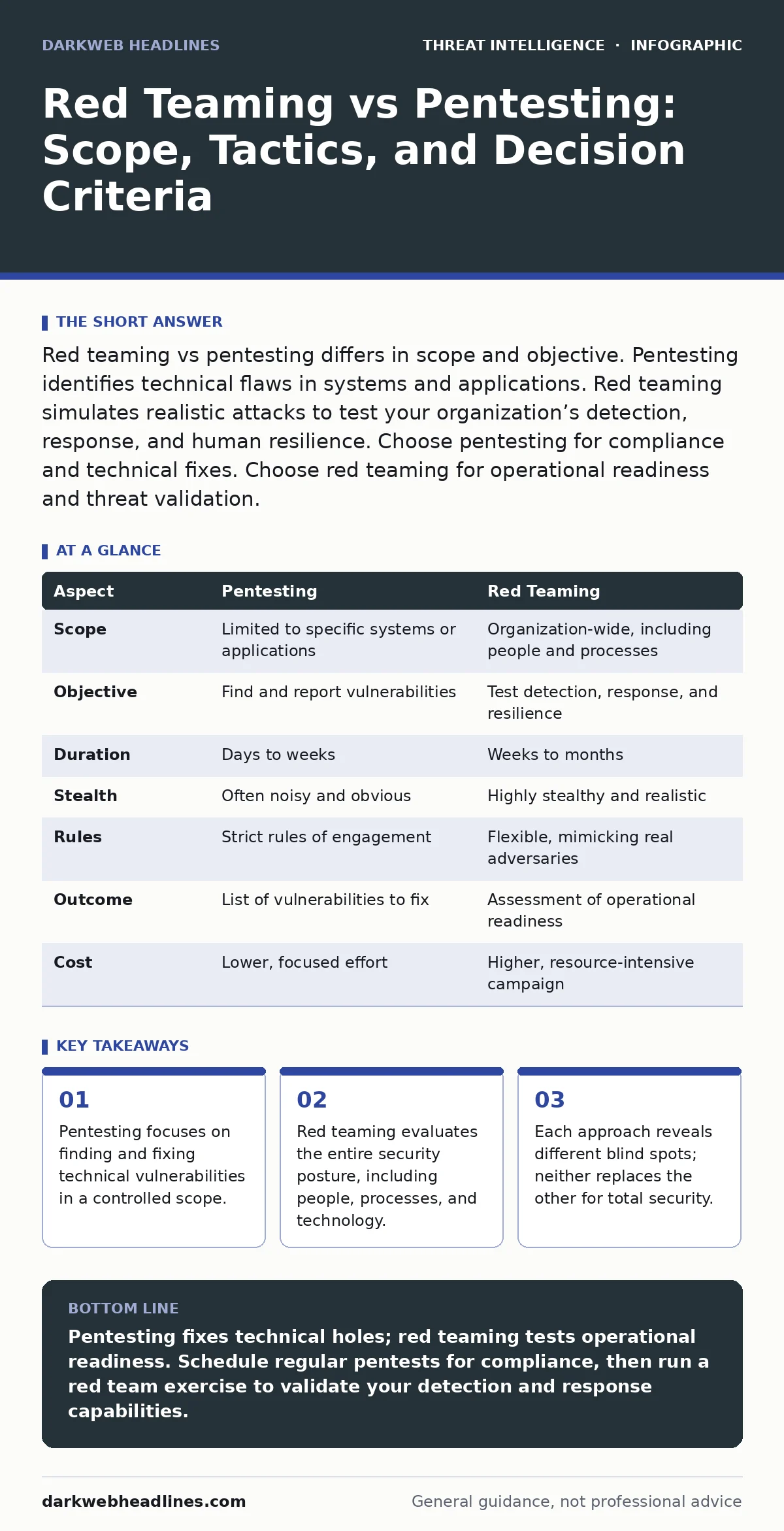
Red teaming vs pentesting differs in scope and objective. Pentesting identifies technical flaws in systems and applications. Red teaming simulates realistic attacks to test your organization’s detection, response, and human resilience. Choose pentesting for compliance and technical fixes. Choose red teaming for operational readiness and threat validation.
The Core Difference Between Red Teaming and Pentesting
Red teaming vs pentesting represents a distinction between breadth and depth in security assessment. Pentesting is a technical audit that seeks to find as many vulnerabilities as possible within a defined scope. Red teaming is an operational exercise that simulates a realistic adversary to test how well your defenses detect and respond to an attack. Pentesting asks if your locks are strong. Red teaming asks if anyone hears when the locks are picked.
What Is Pentesting?
Pentesting, or penetration testing, involves authorized attempts to exploit vulnerabilities in a system. Testers use known techniques to find weaknesses in code, configurations, or network settings. The goal is to identify flaws before attackers do. Pentesters work within strict rules of engagement. They report findings so you can patch the issues. This process is repeatable and focused on technical remediation. It does not typically test your incident response team or physical security measures.
What Is Red Teaming?
Red teaming simulates a full-scale attack against your organization. The red team acts like a real adversary, using multiple attack vectors. This may include social engineering, physical intrusion, and technical exploitation. The goal is to reach a specific objective, such as accessing sensitive data. Blue teams monitor the attack in real time. This tests your detection capabilities and response procedures. Red teaming reveals gaps in your overall security posture, not just technical flaws. It measures how well your people and processes work together under pressure.
Point-by-Point Comparison of Approaches
| Aspect | Pentesting | Red Teaming |
|---|---|---|
| Scope | Limited to specific systems or applications | Organization-wide, including people and processes |
| Objective | Find and report vulnerabilities | Test detection, response, and resilience |
| Duration | Days to weeks | Weeks to months |
| Stealth | Often noisy and obvious | Highly stealthy and realistic |
| Rules | Strict rules of engagement | Flexible, mimicking real adversaries |
| Outcome | List of vulnerabilities to fix | Assessment of operational readiness |
| Cost | Lower, focused effort | Higher, resource-intensive campaign |
When to Choose Pentesting
Choose pentesting when you need to meet compliance requirements. Many regulations require regular vulnerability assessments. Pentesting provides the documentation needed for audits. It is also the right choice when you deploy new software or infrastructure. You need to know if the new system introduces weaknesses. Pentesting gives you a clear list of technical issues to fix. It is efficient for maintaining a baseline level of security. You can schedule these tests regularly to catch new vulnerabilities.
See also: Deep Web Intelligence: Why It Changes Security Decisions · Cyber Espionage Myths: Why State Actors Fail and How They Actually Operate
When to Choose Red Teaming
Choose red teaming when you want to test your incident response. You need to know if your security operations center can detect a sophisticated attack. Red teaming reveals how well your teams communicate during a crisis. It also tests your physical security and employee awareness. Suppose you suspect your current defenses are too technical. Red teaming shows if human factors are your weak link. This approach is valuable before major organizational changes. It helps you understand your true risk exposure.
Where the Two Approaches Overlap
Both methods involve authorized attacks on your systems. They both aim to improve your security posture. Pentesting findings can inform red team strategies. A red team might use pentesting results to identify easy entry points. Both require skilled professionals who understand attack techniques. The insights from both can improve your threat intelligence feeds. You should not view them as competitors. They are complementary tools in your security toolkit. Using both gives you a complete picture of your risks.
Integrating Findings Into Your Defense
The value of these tests lies in what you do with the results. Pentesting results should go directly to your development and IT teams. Red teaming results should inform your SOC playbooks and incident response plans. You must update your log management systems to capture the activity seen during red teaming. This ensures you can detect similar attacks in the future. Regular reviews of these findings keep your defenses current. Ignoring the results wastes the investment and leaves you exposed.
Key takeaways
- Pentesting focuses on finding and fixing technical vulnerabilities in a controlled scope.
- Red teaming evaluates the entire security posture, including people, processes, and technology.
- Each approach reveals different blind spots; neither replaces the other for total security.
Pentesting fixes technical holes; red teaming tests operational readiness. Schedule regular pentests for compliance, then run a red team exercise to validate your detection and response capabilities.
Frequently asked questions
Can I do red teaming and pentesting at the same time?
You can, but it complicates the results. Pentesting noise can mask red team activity. It is better to sequence them: pentest first to fix obvious flaws, then red team to test the hardened environment.
Do I need external experts for both?
External experts provide unbiased perspectives. Internal teams may have blind spots. Outsourcing ensures you face techniques you might not anticipate. It also validates your external-facing security.
How do these relate to OSINT investigations?
OSINT investigations gather public data about your organization. Red teams use this data to craft realistic attacks. Pentesters may use OSINT to find exposed assets. Both benefit from the intelligence gathered through open-source methods.
Is red teaming only for large organizations?
No, but the scale differs. Small organizations can run tabletop exercises or limited scope red teaming. The goal is to test your specific critical assets and response procedures, regardless of size.
How this guide was produced: written by the DarkWeb Headlines editorial team with AI assistance, checked against the public references listed below, and reviewed when the facts change. See our editorial policy or report an error.