Security Metrics Checklist for Measurable Defense Posture
Most teams track activity volume while ignoring the delay between detection and response, which is the only metric that predicts actual damage containment.

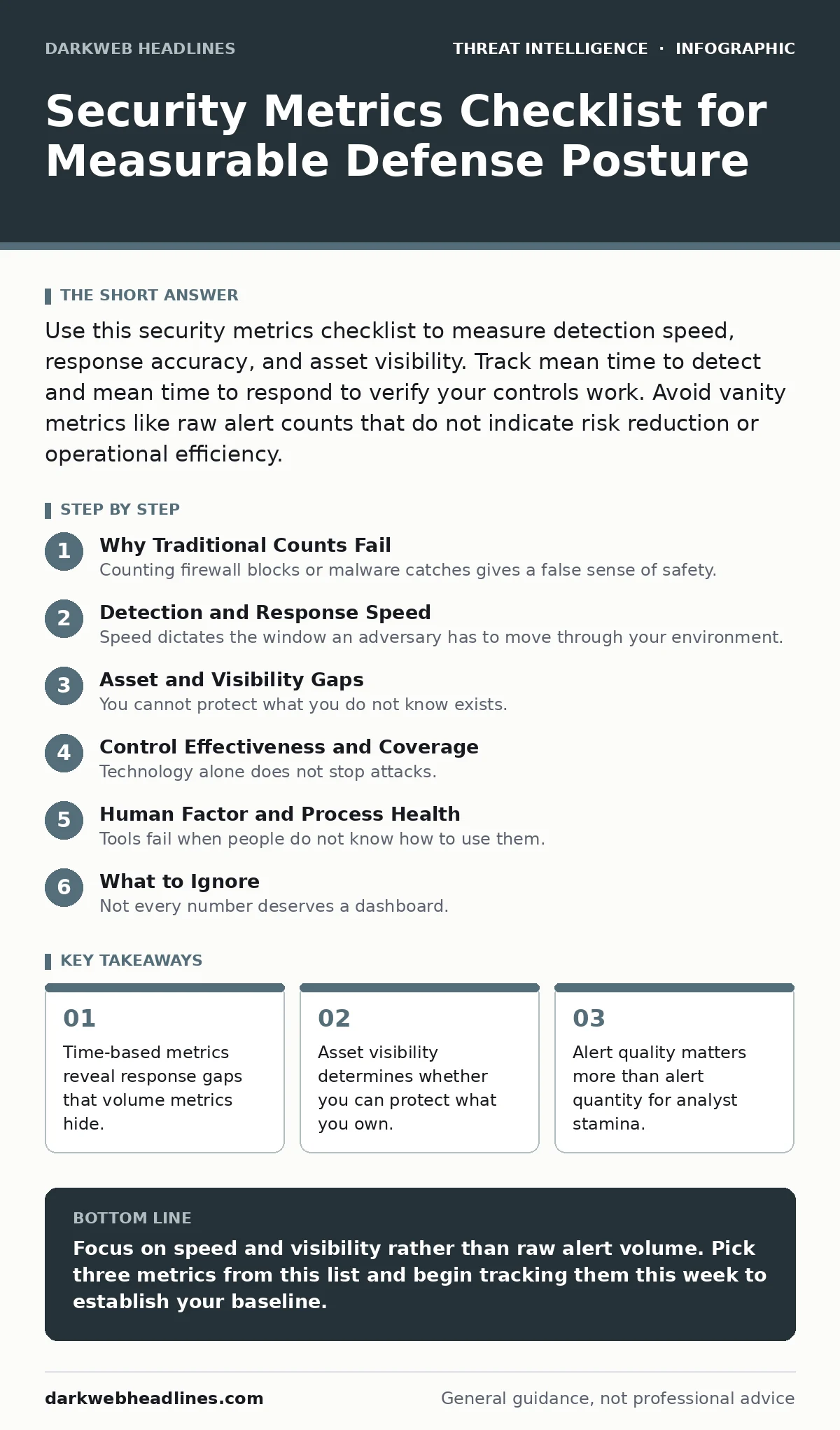
Use this security metrics checklist to measure detection speed, response accuracy, and asset visibility. Track mean time to detect and mean time to respond to verify your controls work. Avoid vanity metrics like raw alert counts that do not indicate risk reduction or operational efficiency.
Why Traditional Counts Fail
Counting firewall blocks or malware catches gives a false sense of safety. These numbers measure effort, not effectiveness. You might process thousands of alerts while a single sophisticated bypass goes unnoticed. The goal is to measure how well your team contains risk, not how busy you appear. This checklist focuses on outcomes that matter for defense.
Detection and Response Speed
Speed dictates the window an adversary has to move through your environment. If you detect a breach weeks later, technical controls may have failed to stop lateral movement. These metrics measure the gap between compromise and containment.
- Mean time to detect: measures how long threats remain hidden before your systems flag them.
- Mean time to respond: tracks the interval between alert generation and the start of remediation actions.
- False positive rate: indicates how much noise your analysts waste time filtering out during investigations.
Slow detection allows threat actors to establish persistence. Fast response limits the scope of data exfiltration or system disruption. You must measure both to understand your true reaction capability.
Asset and Visibility Gaps
You cannot protect what you do not know exists. Unmanaged devices create entry points that bypass your primary security controls. These metrics assess how well your inventory matches your actual infrastructure.
- Unpatched critical vulnerabilities: counts high-severity flaws that remain open beyond the acceptable risk window.
- Orphaned cloud storage buckets: identifies data repositories that lack owners or access controls.
- Privileged account usage anomalies: flags unusual login patterns for accounts with elevated system rights.
Hidden assets are the primary fuel for undetected breaches. Regular network enumeration helps find these gaps before attackers do. If your inventory is stale, your security controls are likely misconfigured.
Control Effectiveness and Coverage
Technology alone does not stop attacks. You need to verify that your tools are configured to catch the behaviors you care about. These metrics test whether your defenses actually trigger during simulated or real threats.
- Log retention compliance: verifies that audit trails are stored long enough for forensic analysis.
- Coverage of critical processes: measures how many high-value business functions have specific monitoring rules.
- Configuration drift detection: alerts when security settings deviate from your approved baseline standards.
A tool that is installed but not configured is useless. Poor log management often leads to evidence loss during an incident. You must prove your controls are active and correctly tuned.
Human Factor and Process Health
Tools fail when people do not know how to use them. Analyst fatigue leads to missed signals and delayed actions. These metrics evaluate the efficiency and health of your security team.
- Alert triage time: measures how long it takes to decide if an alert is a true threat.
- Playbook adherence rate: tracks how often your team follows documented response procedures during incidents.
- Training completion for new tools: ensures staff know how to use updated detection platforms.
- Incident resolution time: calculates the total duration from initial alert to final system restoration.
Refining SOC playbooks reduces hesitation during high-stress events. When your team knows the exact steps for common threats, response becomes predictable. This consistency is harder to measure than raw speed, but it is more valuable.
See also: How SOC Playbooks Work: Mechanism, Limits, and Execution · Deep Web Intelligence: Why It Changes Security Decisions
What to Ignore
Not every number deserves a dashboard. Vanity metrics create work without adding security value. Tracking these items often distracts from real risks.
- Total number of firewall drops: does not indicate if high-value attacks are getting through other paths.
- Daily login counts: provides no insight into compromised credentials or malicious access.
- Raw malware file names: tells you nothing about the technique or impact of the malware family.
- Number of security patches available: does not reflect whether you have applied the critical ones.
Focusing on volume creates a illusion of control. You may feel busy while your actual risk profile remains unchanged. Choose metrics that force you to act, not just to report.
Building Your Baseline
Start by measuring your current state without judgment. Historical data helps you see trends over time. Do not aim for perfection immediately. Aim for improvement in the areas that hurt your organization the most.
Review this checklist quarterly. Adjust items as your infrastructure evolves. The best metric is the one that causes you to fix a broken process.
Key takeaways
- Time-based metrics reveal response gaps that volume metrics hide.
- Asset visibility determines whether you can protect what you own.
- Alert quality matters more than alert quantity for analyst stamina.
Focus on speed and visibility rather than raw alert volume. Pick three metrics from this list and begin tracking them this week to establish your baseline.
Frequently asked questions
How often should I review my security metrics?
Review key metrics weekly to catch immediate trends and anomalies. Conduct a deeper analysis monthly to adjust configurations and strategies based on longer-term patterns.
What is the difference between MTTD and MTTR?
Mean time to detect measures how long a threat stays hidden. Mean time to respond measures how long it takes to start fixing the problem after detection. Both are needed to gauge total exposure.
Should I track metrics for every security tool?
No. Focus on metrics that tie to your most critical assets and highest risks. Tracking every tool creates noise and dilutes your team's attention from the most dangerous threats.
How do I prove my security team is effective?
Show reductions in mean time to respond and improvements in first-response accuracy. These demonstrate that your team contains threats faster and with fewer errors over time.
How this guide was produced: written by the DarkWeb Headlines editorial team with AI assistance, checked against the public references listed below, and reviewed when the facts change. See our editorial policy or report an error.