Authorization Bypass Vulnerabilities Explained for Beginners
Authorization bypass flaws let users access data they should not see by tricking the system into trusting their identity without proper permission checks.

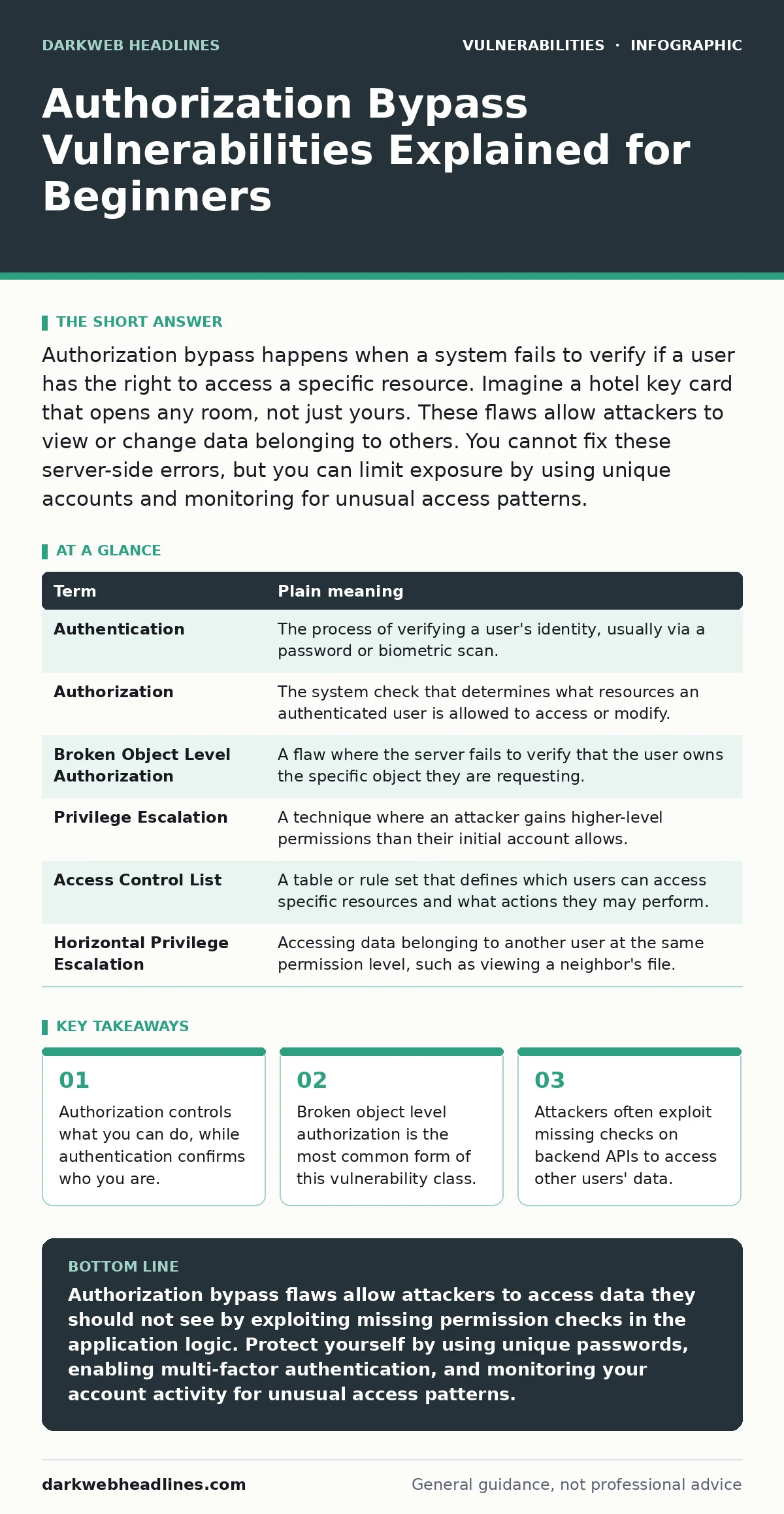
Authorization bypass happens when a system fails to verify if a user has the right to access a specific resource. Imagine a hotel key card that opens any room, not just yours. These flaws allow attackers to view or change data belonging to others. You cannot fix these server-side errors, but you can limit exposure by using unique accounts and monitoring for unusual access patterns.
The Hotel Key Card Analogy
Imagine a large hotel with thousands of rooms. You check in and receive a key card. Authentication is the process of verifying your identity at the front desk to receive that card. Authorization is the mechanism that ensures your card only opens your specific room and the gym, but not the safe or other guests' suites. An authorization bypass vulnerability occurs when the electronic lock fails to check which rooms your card is allowed to open. Instead, it simply accepts the card and unlocks every door. You hold a valid credential, but the system ignores the rules that limit your access.
Defining the Security Terms
Understanding the specific mechanics requires clear definitions. These terms often appear in technical reports and vulnerability databases.
| Term | Plain meaning |
|---|---|
| Authentication | The process of verifying a user's identity, usually via a password or biometric scan. |
| Authorization | The system check that determines what resources an authenticated user is allowed to access or modify. |
| Broken Object Level Authorization | A flaw where the server fails to verify that the user owns the specific object they are requesting. |
| Privilege Escalation | A technique where an attacker gains higher-level permissions than their initial account allows. |
| Access Control List | A table or rule set that defines which users can access specific resources and what actions they may perform. |
| Horizontal Privilege Escalation | Accessing data belonging to another user at the same permission level, such as viewing a neighbor's file. |
How These Flaws Manifest in Software
Developers often assume that hiding a URL or removing a button prevents access. This is a dangerous assumption. The server must enforce rules independently of the interface. If a web application sends a request to GET /api/users/123/profile, the server must verify that the logged-in user is actually user 123. If the developer forgets this check, an attacker can change the number to 124 and view that profile. This is a direct failure of authorization logic. The system authenticates the attacker as a valid user but fails to authorize the specific action on the foreign resource.
The Impact on Ordinary Users
You may wonder why this matters if you do not write code. These vulnerabilities expose personal data, financial records, and private communications. When a service suffers from broken authorization, attackers can scrape large amounts of user data in minutes. They do not need to guess passwords. They only need to find a predictable pattern in how the application handles requests. This means your data can be stolen even if your password is strong and unique. The failure lies in the application's logic, not in your personal security habits.
Simple Safety Habits for Users
You cannot patch server-side code, but you can reduce your risk surface. Use unique credentials for every service. This prevents an attacker from using a leaked password from one site to access another. Enable multi-factor authentication where possible. This adds a layer of verification that makes account takeover harder. Monitor your account activity regularly. Look for login attempts from unfamiliar locations or devices. If you see unauthorized actions, change your password immediately and contact support. These steps do not fix the vulnerability, but they limit the damage if an attacker targets your account.
See also: File Upload Vulnerabilities: How Malicious Files Break Web Apps
Understanding Related Vulnerability Classes
Authorization bypass often overlaps with other security issues. Privilege escalation vulnerabilities allow a user to gain higher permissions, such as becoming an administrator. File upload vulnerabilities can let attackers place malicious scripts on the server, which may then execute with elevated privileges. Clickjacking tricks users into clicking hidden buttons, potentially triggering unauthorized actions.
Understanding CWE weakness categories helps you identify where these flaws fall in standard classification systems. Dynamic application security testing (DAST) is a method used to find these issues by attacking the running application. Prototype pollution can sometimes lead to unauthorized property access in JavaScript environments. Patch Tuesday updates often include fixes for these critical logic errors. Vulnerability management programs ensure these issues are tracked and resolved over time.
Try This Now: 3 Steps to Check Your Exposure
- Review your account settings on major services. Look for a section labeled "Security," "Privacy," or "Connected Apps." Identify any third-party services with full access and revoke those you do not recognize or use.
- Change your password on any service where you suspect an authorization bypass may have occurred. Use a password manager to generate a unique, complex password for each site. This ensures that a breach on one platform does not compromise others.
- Enable account activity notifications. Most major platforms allow you to receive email or push notifications for new logins. This alerts you immediately if an attacker uses your credentials to access your data, allowing you to react before significant damage occurs.
Key takeaways
- Authorization controls what you can do, while authentication confirms who you are.
- Broken object level authorization is the most common form of this vulnerability class.
- Attackers often exploit missing checks on backend APIs to access other users' data.
Authorization bypass flaws allow attackers to access data they should not see by exploiting missing permission checks in the application logic. Protect yourself by using unique passwords, enabling multi-factor authentication, and monitoring your account activity for unusual access patterns.
Frequently asked questions
Can antivirus software detect authorization bypass vulnerabilities?
No, antivirus software scans for known malware signatures and suspicious behavior on your device. It cannot detect logic flaws in the server-side code of the websites you visit.
Is this the same as a password leak?
No, a password leak means your credentials are stolen. An authorization bypass means the system fails to enforce rules even when valid credentials are used correctly.
How do developers prevent these issues?
Developers must implement strict access control checks on every server-side request. They should verify that the user making the request has the right to access the specific resource requested.
Should I stop using web applications?
No, web applications are necessary for modern life. Instead, stay informed about security practices, use strong unique credentials, and monitor your accounts for signs of unauthorized access.
How this guide was produced: written by the DarkWeb Headlines editorial team with AI assistance, checked against the public references listed below, and reviewed when the facts change. See our editorial policy or report an error.