Identity Sprawl: Definition, Hidden Risks, and Control Strategies
Identity sprawl creates invisible attack surfaces where forgotten credentials linger long after projects end, bypassing perimeter defenses entirely.

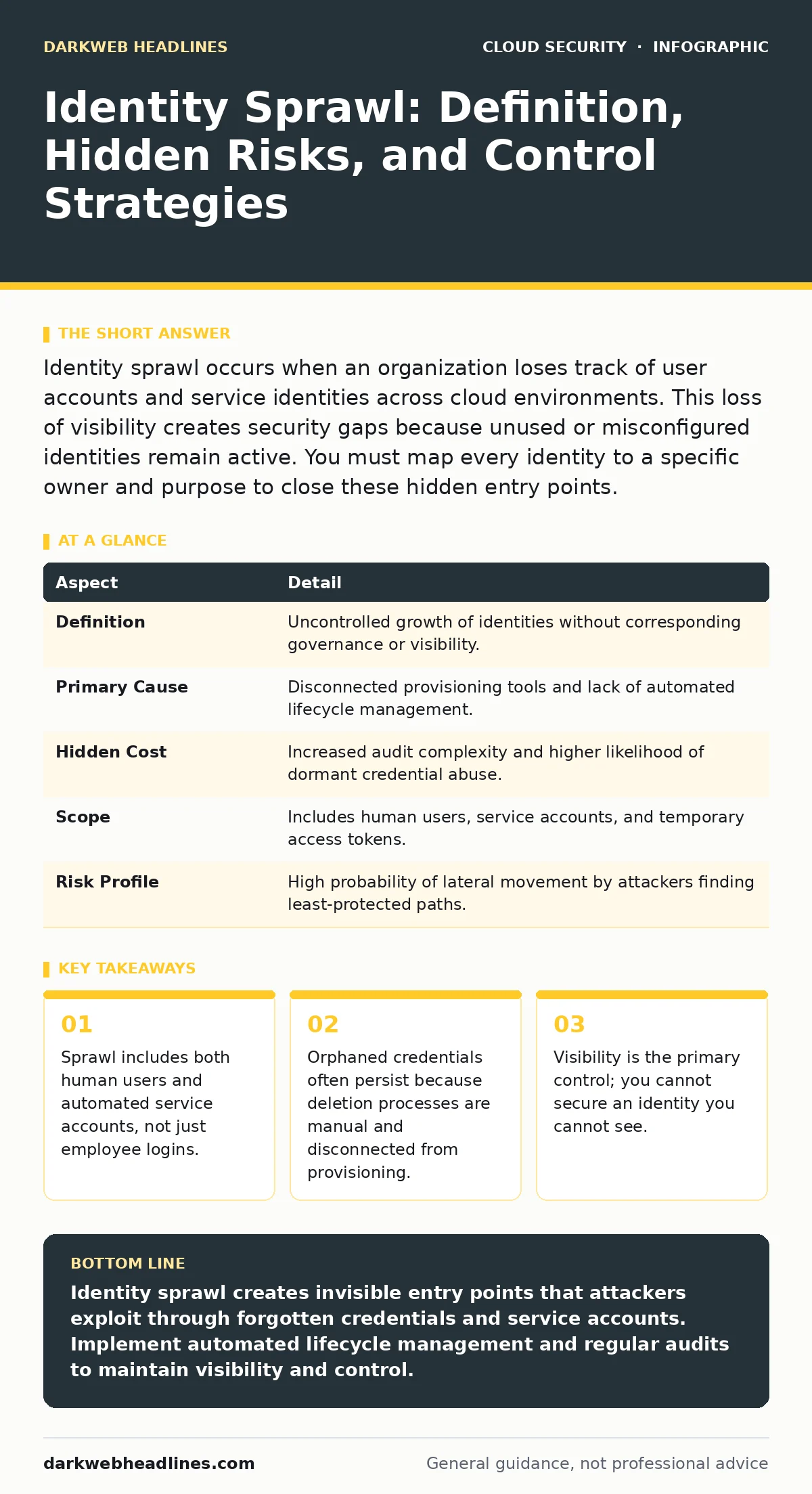
Identity sprawl occurs when an organization loses track of user accounts and service identities across cloud environments. This loss of visibility creates security gaps because unused or misconfigured identities remain active. You must map every identity to a specific owner and purpose to close these hidden entry points.
The Digital Keychain Analogy
Imagine you carry a keychain with fifty keys. Ten open your home and car. Thirty belong to apartments you rented years ago. Five are for storage units you no longer visit. You do not know who has copies of those old keys. If a thief finds a copy of a storage unit key, they cannot enter your home, but they can steal your tools. In cloud security, those tools are your data and compute resources.
Identity sprawl is the accumulation of unused, unmanaged, or unknown identities within an organization’s digital infrastructure. It is not just about too many users. It is about the loss of context regarding who those users are, what they need, and whether they still need it. When you lose that context, you lose the ability to enforce security policies effectively.
At a Glance: Understanding Sprawl
| Aspect | Detail |
|---|---|
| Definition | Uncontrolled growth of identities without corresponding governance or visibility. |
| Primary Cause | Disconnected provisioning tools and lack of automated lifecycle management. |
| Hidden Cost | Increased audit complexity and higher likelihood of dormant credential abuse. |
| Scope | Includes human users, service accounts, and temporary access tokens. |
| Risk Profile | High probability of lateral movement by attackers finding least-protected paths. |
How Sprawl Develops
Sprawl rarely happens through a single error. It accumulates through small, rational decisions made in isolation. A developer creates a service account to deploy an application. The application succeeds, and the developer moves to a new project. The service account remains active because no one scheduled its deletion. Another team member grants temporary admin rights to fix a bug. The fix works, but the rights are never revoked.
This process repeats across departments. Engineering creates accounts for testing. Marketing creates accounts for vendor access. IT creates accounts for system maintenance. Each team uses different tools to manage these identities. No single dashboard shows the total count. Without a unified view, the organization assumes the sum of its parts is manageable. It is not.
The Two Types of Identities
People often focus only on human users. This is a mistake. Identity sprawl includes two distinct categories. The first is human identity. These are accounts for employees, contractors, and partners. The second is non-human identity. These are service accounts, API keys, and tokens used by applications and scripts to talk to each other.
Non-human identities are often more dangerous. They rarely have multi-factor authentication. They often have broader permissions than necessary because developers want to avoid permission errors during development. They do not log in interactively, so unusual activity is harder to detect. If a human account is stolen, the user might notice a strange login location. If a service account is stolen, the application continues to function normally, hiding the compromise.
What People Usually Get Wrong
A common misconception is that identity sprawl is a problem of scale. Organizations assume that if they have fewer than a thousand users, they are safe. This is false. A small team with five developers can create fifty service accounts in a month. The risk comes from the lack of governance, not the headcount.
Another error is assuming that disabling an account is enough. Disabling prevents login, but it does not remove the permissions associated with that identity. If an attacker uses a stolen token that was issued before the account was disabled, they may still access resources. You must revoke tokens and keys, not just disable the user object.
See also: Identity and Access Management: How Zero Trust Stops Cloud Breaches · Warning Signs of Orphaned Cloud Resources and How to Remediate Them
The Hidden Costs of Sprawl
The immediate risk is unauthorized access. The hidden cost is operational friction. When an incident occurs, investigators must sort through hundreds of identities to find the source. This delays response time. Every unused identity adds noise to security alerts. Security teams become desensitized to alerts because most of them relate to benign activity from dormant accounts.
Sprawl also increases compliance risk. Auditors require proof that access is reviewed and necessary. If you cannot prove who owns an identity or why it exists, you fail the audit. This leads to fines and lost business opportunities. The cost of cleaning up sprawl after an audit is far higher than maintaining visibility from the start.
Reducing the Risk
You reduce sprawl by enforcing a strict lifecycle for every identity. Start with visibility. Use tools that can scan your entire cloud environment and list every identity, regardless of where it was created. Compare this list against your official employee roster and application inventory. Any identity not on those lists is a candidate for removal.
Next, automate the creation and deletion of identities. Manual processes are prone to error. Use policy as code to define how identities are created. This ensures that every new identity has a defined owner, a purpose, and an expiration date. When an employee leaves, the system should automatically disable their account and revoke their tokens.
Integrating with Broader Security
Identity sprawl does not exist in a vacuum. It interacts with other cloud security risks. For example, if you have sprawled identities, you are more vulnerable to cloud privilege escalation because attackers can find low-privileged accounts and escalate them. If you leave keys in public code repository leaks, attackers can use those keys to access sprawled identities.
You should also consider cloud security assessments to identify where your visibility gaps are. These assessments often reveal that your identity and access management policies are not being enforced consistently. By addressing sprawl, you strengthen your defenses against OAuth token abuse and cloud metadata service attacks. These attacks rely on finding weak or forgotten identities to pivot deeper into your network.
The Path Forward
Managing identity sprawl is an ongoing process, not a one-time project. New identities are created every day. Old ones become obsolete. You must build a culture where every identity has an owner. When you create an identity, you are responsible for its entire life. When you delete it, you must verify that it is gone.
Start by mapping your current state. Identify the biggest sources of sprawl. Are they service accounts? Are they contractor accounts? Prioritize your cleanup efforts based on risk. Remove the highest-risk identities first. Then, implement automation to prevent future sprawl. This approach reduces your attack surface and simplifies your security operations.
Key takeaways
- Sprawl includes both human users and automated service accounts, not just employee logins.
- Orphaned credentials often persist because deletion processes are manual and disconnected from provisioning.
- Visibility is the primary control; you cannot secure an identity you cannot see.
Identity sprawl creates invisible entry points that attackers exploit through forgotten credentials and service accounts. Implement automated lifecycle management and regular audits to maintain visibility and control.
Frequently asked questions
How do I find orphaned service accounts?
Use cloud-native tools to list all identities and cross-reference them with active applications and employee records. Any account without a clear owner or associated resource is likely orphaned.
Is identity sprawl the same as poor access control?
No. Poor access control means users have too much permission. Sprawl means you have too many identities and do not know who they are. Sprawl makes poor access control harder to detect and fix.
Can I prevent sprawl with just a password policy?
No. Password policies secure active accounts but do not address the existence of unnecessary accounts. You need lifecycle management and visibility tools to prevent sprawl.
How often should I review identities?
Review high-risk identities quarterly and standard identities annually. Automate reviews where possible to ensure consistency and reduce manual effort.
How this guide was produced: written by the DarkWeb Headlines editorial team with AI assistance, checked against the public references listed below, and reviewed when the facts change. See our editorial policy or report an error.