Session Hijacking: The Step-by-Step Breakdown of Token Theft
Attackers rarely break encryption to steal sessions; they usually wait for the application to hand over the key, making the client environment the weakest link in the chain.

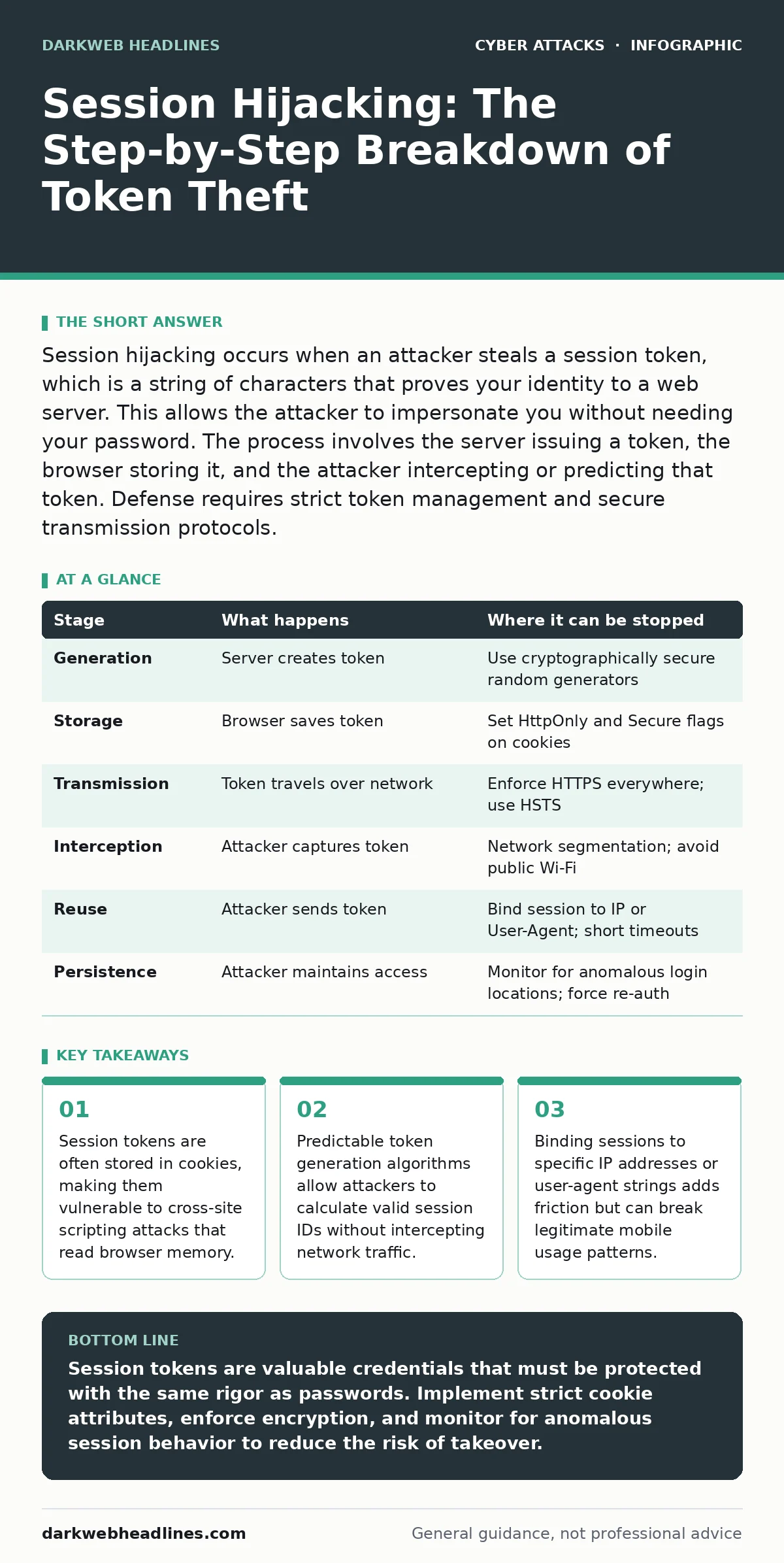
Session hijacking occurs when an attacker steals a session token, which is a string of characters that proves your identity to a web server. This allows the attacker to impersonate you without needing your password. The process involves the server issuing a token, the browser storing it, and the attacker intercepting or predicting that token. Defense requires strict token management and secure transmission protocols.
The Mechanics of Identity Delegation
Web applications cannot remember every user who visits them. To manage this, servers create a session, which is a temporary record of your interaction. When you log in, the server generates a session token. This token is a unique string of characters that acts as a digital key. The server stores the associated data on its end and sends the token to your browser. Your browser then sends this token with every subsequent request to prove you are the same person.
This delegation of trust is efficient but introduces a single point of failure. If an attacker obtains the token, they possess the same access rights as you. The server treats the token as absolute proof of identity. It does not verify who holds the token, only that the token is valid. This design assumes the transport channel and the client device are secure.
### Stage 1: Token Generation and Issuance
The process begins when you authenticate with credentials. The server verifies these details and creates a new session entry. It then generates a token to represent this session. The quality of this token determines the baseline security of the session. If the generation algorithm uses weak randomness, the token may be predictable.
Imagine a system that uses the current time and a simple counter to create tokens. An attacker who knows the approximate time of your login can generate a list of likely tokens. They can then try each one until they find a match. This is not interception; it is calculation. Strong pseudo-random number generators are required to prevent this. The token must be long and complex enough that guessing it is computationally infeasible.
### Stage 2: Client-Side Storage
Once generated, the token must be stored on your device. Web applications typically use HTTP cookies for this purpose. A cookie is a small piece of data stored by the browser. It is sent automatically with requests to the domain that created it. This convenience is also its danger. If the cookie lacks proper security flags, other scripts running on the page can read it.
The HttpOnly flag prevents JavaScript from accessing the cookie. Without this flag, a malicious script injected into the page can steal the token. This is often the result of a cross-site scripting vulnerability. The SameSite attribute restricts how cookies are sent with cross-site requests. This helps prevent certain types of cross-site request forgery. If these attributes are missing or misconfigured, the token sits in an exposed container.
### Stage 3: Transmission and Exposure
The token travels between your browser and the server with every request. If this communication occurs over an unencrypted connection, the token is visible to anyone monitoring the network traffic. This is known as a man-in-the-middle attack. On public Wi-Fi networks, attackers can easily capture this traffic.
Even with encryption, the token is vulnerable if the application has flaws in how it handles redirects or third-party integrations. Some applications inadvertently send tokens to other domains through referrer headers or image tags. This leaks the token to external servers. The attacker does not need to break encryption; they simply wait for the application to send the token to the wrong place.
### Stage 4: Interception or Prediction
The attacker must now acquire the token. The most common method is interception. This can happen via network sniffing on insecure connections or through malware installed on the user’s device. Keyloggers can capture the token if it is typed into a URL bar or form, though this is rare for standard cookies.
Another method is side-channel prediction. If the token generation is flawed, the attacker predicts the value. A third method involves social engineering to trick the user into revealing the token or clicking a link that transfers it. This often overlaps with clone phishing, where a fake site mimics the real one to capture credentials and tokens. The attacker relies on the user’s trust in the interface.
### Stage 5: Token Reuse and Impersonation
With the token in hand, the attacker sends it to the server. The server receives the request and sees a valid token. It checks its records and finds the associated session. It assumes the request is legitimate. The attacker is now impersonating you. They can view your data, perform actions, and change settings.
The server has no way to distinguish between your browser and the attacker’s script. Both present the same token. This is the core weakness of stateless authentication. The identity is tied to the token, not the device or the network context. Unless the application binds the session to additional factors, the impersonation is seamless.
### Stage 6: Persistence and Escalation
Some attackers aim for short-term gain, while others seek persistence. They may change your password to lock you out. This is account takeover. They might install backdoors or add new authorized devices. The goal is to maintain access even if you detect the breach and try to log in again.
The attacker may also use your session to launch further attacks. If you have access to sensitive systems, they can pivot deeper. This lateral movement relies on the privileges your session grants. The longer the session remains active, the more damage can be done. Session timeouts help limit this window, but they are often set too long for security.
Where Defense Fails
Defense must be layered. Encryption protects the token in transit. Secure cookie attributes protect it in storage. Strong randomness protects it from prediction. However, these measures do not stop an attacker who compromises the client device directly. If malware runs on your computer, it can read memory and steal the token regardless of server-side protections.
This is why device health matters. A compromised endpoint renders server-side security irrelevant. You must also consider the human factor in security. Users often ignore warnings or click suspicious links, enabling the initial compromise. Technical controls can only mitigate what the user allows.
| Stage | What happens | Where it can be stopped |
|---|---|---|
| Generation | Server creates token | Use cryptographically secure random generators |
| Storage | Browser saves token | Set HttpOnly and Secure flags on cookies |
| Transmission | Token travels over network | Enforce HTTPS everywhere; use HSTS |
| Interception | Attacker captures token | Network segmentation; avoid public Wi-Fi |
| Reuse | Attacker sends token | Bind session to IP or User-Agent; short timeouts |
| Persistence | Attacker maintains access | Monitor for anomalous login locations; force re-auth |
Beyond the Basics
Session hijacking is not just a web problem. It applies to any system using token-based authentication. API keys, access tokens, and refresh tokens are all vulnerable. The principles remain the same: protect the token in storage, in transit, and from prediction.
Consider BGP hijacking, which can redirect traffic to an attacker’s server. This is a network-level attack that facilitates session interception. Similarly, ARP spoofing on local networks can intercept packets before they leave your device. These attacks highlight that security is not just about the application code. The underlying infrastructure must also be secure.
Typosquatting can lead users to fake sites that steal tokens. DMARC helps prevent email spoofing that might deliver such phishing links. CAPTCHA can slow down automated attacks but does not stop manual hijacking. Callback verification adds a layer of confirmation for sensitive actions. These complementary measures reduce the attack surface.
Key takeaways
- Session tokens are often stored in cookies, making them vulnerable to cross-site scripting attacks that read browser memory.
- Predictable token generation algorithms allow attackers to calculate valid session IDs without intercepting network traffic.
- Binding sessions to specific IP addresses or user-agent strings adds friction but can break legitimate mobile usage patterns.
Session tokens are valuable credentials that must be protected with the same rigor as passwords. Implement strict cookie attributes, enforce encryption, and monitor for anomalous session behavior to reduce the risk of takeover.
Frequently asked questions
Can changing my password stop a session hijacker?
Not immediately. The hijacker holds a valid session token that remains active until it expires or is invalidated. You must explicitly log out of all devices or use an admin function to terminate active sessions.
Does two-factor authentication prevent session hijacking?
It prevents the initial account takeover by credentials. However, if the attacker steals the session token after you have already authenticated, 2FA does not protect the active session. The token bypasses the login challenge.
How long should a session last?
There is no single correct duration. It depends on the sensitivity of the data. High-risk applications should use short timeouts and require re-authentication for critical actions. Longer sessions increase the window of opportunity for attackers.
What is the difference between session hijacking and session fixation?
Session hijacking involves stealing a valid token. Session fixation involves forcing a user to use a known token, often by setting it before they log in. Both result in unauthorized access, but the attack vector differs.
How this guide was produced: written by the DarkWeb Headlines editorial team with AI assistance, checked against the public references listed below, and reviewed when the facts change. See our editorial policy or report an error.