Stop XXE Attacks: Disable Entity Processing in XML Parsers
Disabling external entity resolution at the parser level removes the attack surface before malicious data can reach your application logic or file system.
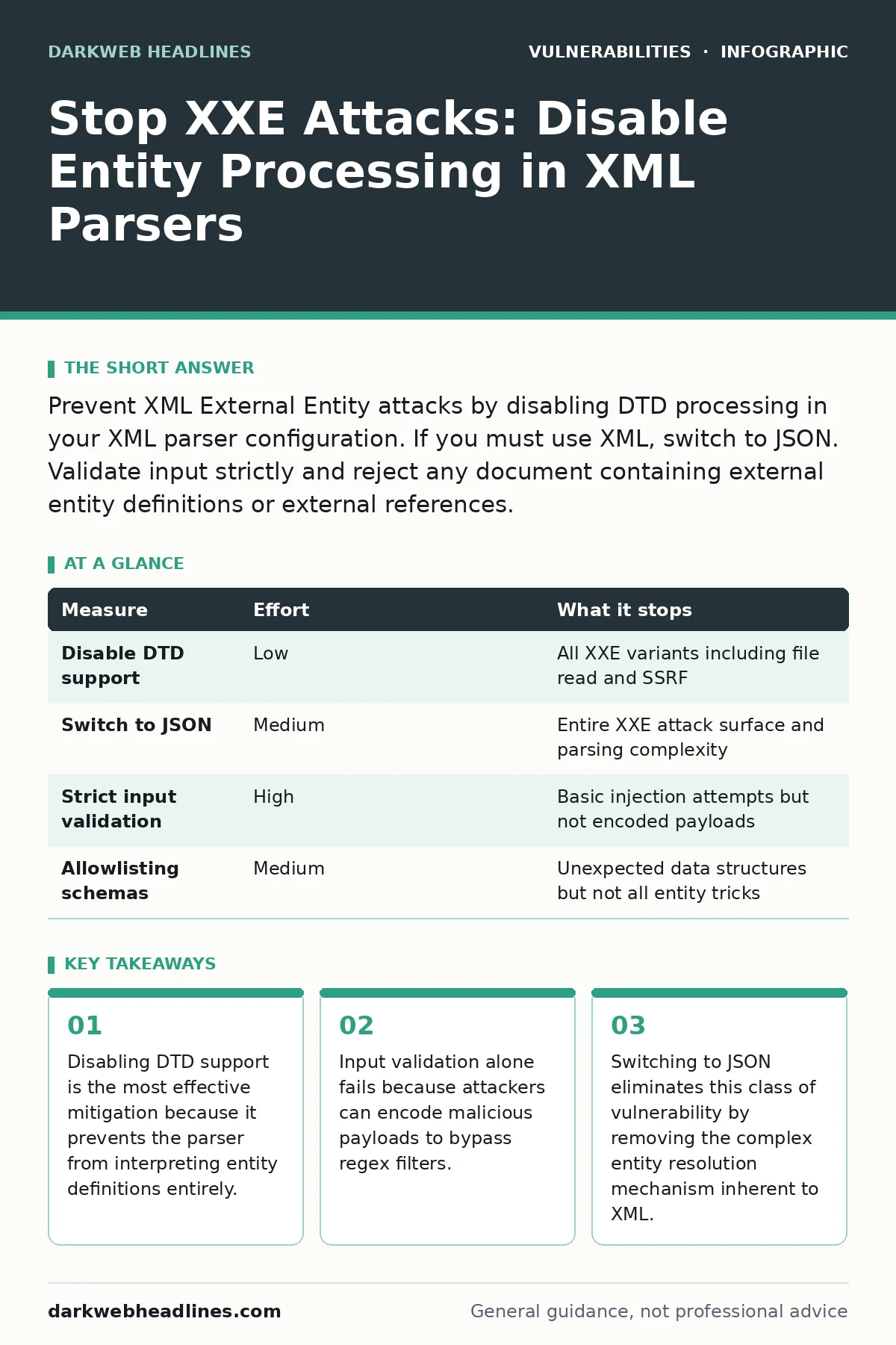
Prevent XML External Entity attacks by disabling DTD processing in your XML parser configuration. If you must use XML, switch to JSON. Validate input strictly and reject any document containing external entity definitions or external references.
Disable DTD Processing at the Parser Level
The most effective defense against XML External Entity attacks is to disable Document Type Definition processing within your XML parser. Most modern libraries provide a configuration flag to turn off external entity resolution. When you enable this setting, the parser treats the entire XML document as plain data. It refuses to fetch external resources or expand internal entities.
This measure stops the attack at the source. The parser never sends HTTP requests to internal servers. It never reads local files. You remove the mechanism that allows an attacker to bridge the gap between the application and the underlying system. This is a quick win because it requires only a configuration change, not a code rewrite.
Migrate to JSON Where Possible
XML was designed for complex document structures with features like namespaces and entity references. These features introduce significant parsing complexity. JSON lacks these features. It has a simpler data model that does not support external entities or DTDs.
If your application communicates via APIs, consider replacing XML with JSON. This migration eliminates the XXE vulnerability class entirely. It also reduces parsing overhead and simplifies validation. You do not need to worry about entity injection because the format does not support it. This is a strategic shift that pays dividends in security and performance.
| Measure | Effort | What it stops |
|---|---|---|
| Disable DTD support | Low | All XXE variants including file read and SSRF |
| Switch to JSON | Medium | Entire XXE attack surface and parsing complexity |
| Strict input validation | High | Basic injection attempts but not encoded payloads |
| Allowlisting schemas | Medium | Unexpected data structures but not all entity tricks |
Enforce Strict Schema Validation
If you cannot migrate to JSON, you must enforce strict schema validation. Define a precise schema that describes the exact structure of the XML you expect. Reject any document that deviates from this schema. The schema should explicitly forbid DTD declarations and external entity references.
This adds a layer of defense in depth. Even if the parser configuration is misconfigured, the schema validator should reject malicious documents before they are processed. You must ensure that the schema processor itself is secure and does not introduce new vulnerabilities. This approach requires maintenance as your data structures evolve.
Implement Server-Side Input Sanitization
Input sanitization involves scanning incoming XML for dangerous patterns. Remove or reject any document containing these strings. This is a detective control that catches obvious attacks.
Do not rely on this method alone. Encoded payloads can bypass string matching. For example, an attacker might use Unicode normalization or different character encodings to hide the malicious tags. Sanitization is a secondary measure that supports primary defenses like parser hardening. It helps catch accidental misconfigurations or legacy code issues.
Restrict Network Access from Parse Services
The process running your XML parser should have limited network access. Use firewalls and network segmentation to prevent the parser from reaching internal databases or sensitive services. If the parser attempts to fetch an external entity, the network request should fail.
This limits the damage if an attack succeeds. The attacker cannot access internal resources if the parser cannot reach them. This is a containment strategy. It does not prevent the attack but reduces its impact. You should apply the principle of least privilege to the service account running the parser.
See also: 7 Mistakes That Leave Microsoft Exchange Servers Open to Attack · Business Logic Vulnerability Response: Recovery and Prevention Steps
Monitor for Anomalous Parser Behavior
Set up monitoring to detect unusual parser activity. Look for failed network connections originating from the parsing service. Alert on attempts to access local file paths via the parser. These indicators suggest an active exploitation attempt.
This helps you identify misconfigured parsers or new attack vectors. It provides visibility into your security posture. You can use this data to refine your defenses. Monitoring is not a prevention measure but it supports your vulnerability management programs by providing early warning signs.
Close Checklist for Today
- Audit your XML parsers and disable DTD processing in all configurations.
- Identify APIs using XML and plan a migration to JSON where feasible.
- Review network rules to ensure parsing services cannot access internal resources.
These steps provide immediate risk reduction. They address the root cause of XXE vulnerabilities. Implementing them requires minimal effort but delivers significant security benefits. You strengthen your application against a well-known class of attacks.
Key takeaways
- Disabling DTD support is the most effective mitigation because it prevents the parser from interpreting entity definitions entirely.
- Input validation alone fails because attackers can encode malicious payloads to bypass regex filters.
- Switching to JSON eliminates this class of vulnerability by removing the complex entity resolution mechanism inherent to XML.
Frequently asked questions
Can I prevent XXE by just checking the XML content for malicious tags?
No, input validation alone is insufficient. Attackers can use encoding techniques to bypass string filters. You must disable entity processing at the parser level.
Is JSON completely immune to XML External Entity attacks?
Yes, JSON does not support DTDs or external entities. It lacks the features that enable XXE. This makes it a safer choice for data exchange.
Do I need to worry about XXE if I use a modern programming language?
Yes, modern languages still use XML parsers that may have DTD processing enabled by default. You must explicitly disable it. The vulnerability lies in the parser configuration, not the language itself.
How does this relate to other file upload vulnerabilities?
XXE is distinct from file upload flaws. File upload vulnerabilities allow arbitrary code execution via stored files. XXE exploits the parser’s ability to resolve external references. Both require strict input handling but target different mechanisms.
How this guide was produced: written by the DarkWeb Headlines editorial team with AI assistance, checked against the public references listed below, and reviewed when the facts change. See our editorial policy or report an error.