How BGP Hijacking Works: Step-by-Step Route Manipulation
BGP hijacking exploits the trust-based design of internet routing, allowing attackers to redirect traffic without breaking encryption or stealing credentials.

BGP hijacking occurs when an attacker announces ownership of IP addresses they do not control. This tricks routers into sending traffic to the attacker’s network. The process relies on the lack of cryptographic validation in Border Gateway Protocol updates, making it a silent and effective method for intercepting or disrupting data flows.
The Foundation of Internet Routing
The internet operates as a collection of autonomous systems, which are large networks managed by single organizations. These systems exchange routing information to determine the most efficient path for data packets. The protocol that facilitates this exchange is the Border Gateway Protocol, or BGP. It functions as the postal service of the internet, deciding which network should receive traffic destined for a specific address.
This system relies on a principle of trust rather than verification. When one autonomous system tells another that it can reach a specific set of IP addresses, the receiving system generally accepts this claim. There is no built-in mechanism to prove that the speaker actually owns those addresses. This design choice prioritizes speed and scalability over security, creating a vulnerability that attackers can exploit.
Stage 1: Reconnaissance and Target Selection
An attacker begins by identifying a target that offers a high reward for minimal effort. They often look for networks with poorly configured routing policies or those that manage large blocks of IP addresses. The attacker studies the public routing tables to see how traffic currently flows to the target. They analyze the existing paths to understand which upstream providers carry the traffic.
This phase is quiet and leaves no immediate trace. The attacker is not interacting with the target directly but is observing the global routing infrastructure. They look for gaps in the target’s defensive posture, such as a lack of route filtering or an over-reliance on a single provider. Understanding the topology is necessary because the attack requires precise timing and specific announcements to succeed.
Stage 2: Crafting the False Route Announcement
The attacker prepares a BGP update message that claims ownership of the target’s IP address block. This message includes the target’s prefix, which is the range of IP addresses, and the attacker’s own autonomous system number. The attacker may also add additional path information to make their route appear more attractive to routers.
Routers use specific metrics to choose the best path, such as the length of the AS path or local preference settings. By crafting their announcement carefully, the attacker can make their route look shorter or more desirable than the legitimate one. This is a technical manipulation of the routing logic, not a brute-force attack. The goal is to make the network naturally prefer the attacker’s path over the correct one.
Stage 3: Injection into the Routing Table
The attacker sends the false BGP update to their upstream internet service provider or peer. This provider then propagates the update to its own peers, and the information spreads across the internet. This propagation happens automatically and rapidly, as routers are designed to share routing changes quickly to maintain connectivity.
As the update travels, other routers update their routing tables to reflect the new, shorter path to the target. This process is known as route convergence. The attacker does not need to contact every router on the internet; they only need to convince a few key nodes. Once these nodes accept the false route, they pass it on, creating a cascading effect that redirects traffic globally or regionally.
Stage 4: Traffic Diversion and Interception
Once the routing tables are updated, internet traffic destined for the target begins flowing toward the attacker’s network. This diversion can be complete or partial, depending on how many providers accepted the false route. The attacker now sits in the middle of the communication path. They can choose to drop the traffic, causing a denial of service, or they can forward it to the actual destination while inspecting the contents.
If the traffic is encrypted using Transport Layer Security, the attacker cannot read the contents in real-time. However, they can still degrade performance by introducing latency or packet loss. For unencrypted traffic, the attacker can read, modify, or steal data. This stage is where the impact becomes visible to users, often manifesting as slow websites or unexpected login prompts.
See also: ARP Spoofing vs IP Spoofing: Key Differences, Risks, and Defenses · Command and Control Traffic Myths That Blind Defenders
Stage 5: Detection and Mitigation
The attack remains active until the legitimate network operator or a monitoring service detects the anomaly. Detection often comes from external monitoring tools that track BGP announcements and alert on unexpected changes. The legitimate operator must then withdraw their original route or announce a more specific prefix to override the attacker’s claim.
This process is not instantaneous. It requires coordination with upstream providers to filter out the malicious announcements. Until the correct routes are re-established, traffic may continue to be misdirected. The speed of detection and response is the primary factor in limiting the damage. Automated systems can help, but human verification is often required to avoid disrupting legitimate traffic.
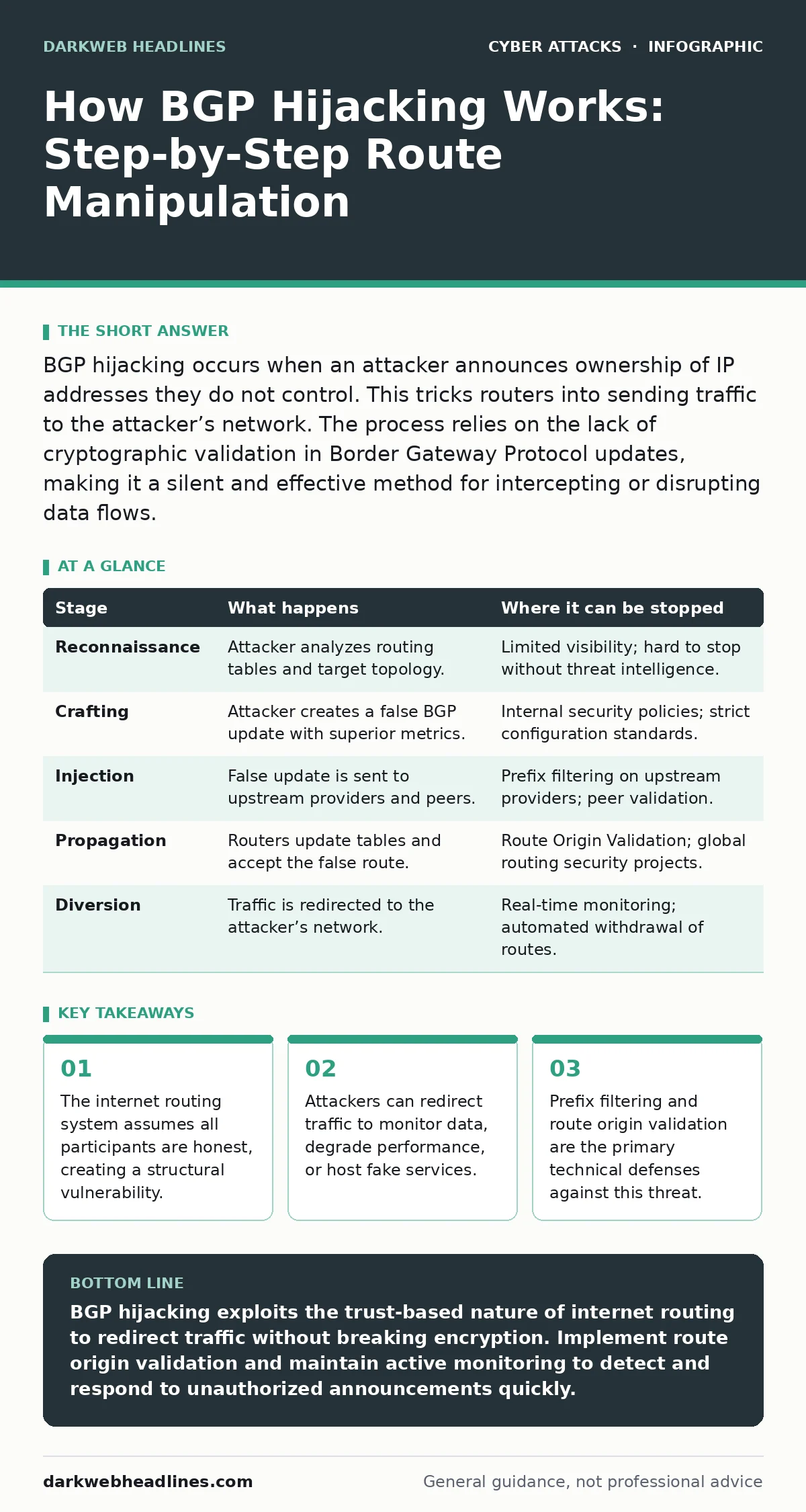
| Stage | What happens | Where it can be stopped |
|---|---|---|
| Reconnaissance | Attacker analyzes routing tables and target topology. | Limited visibility; hard to stop without threat intelligence. |
| Crafting | Attacker creates a false BGP update with superior metrics. | Internal security policies; strict configuration standards. |
| Injection | False update is sent to upstream providers and peers. | Prefix filtering on upstream providers; peer validation. |
| Propagation | Routers update tables and accept the false route. | Route Origin Validation; global routing security projects. |
| Diversion | Traffic is redirected to the attacker’s network. | Real-time monitoring; automated withdrawal of routes. |
The Hidden Cost of Trust
The fundamental flaw in BGP is that it was designed in an era when the internet was small and cooperative. Today, the internet is vast and adversarial, but the protocol still assumes good faith. This creates a hidden cost for every organization: the need to constantly monitor their routing status and rely on third-party providers for security.
Defending against BGP hijacking requires more than just strong passwords or firewalls. It requires a deep understanding of network topology and a willingness to implement complex filtering rules. Organizations that ignore this layer of security are vulnerable to attacks that bypass traditional perimeter defenses entirely. The attack vector is the infrastructure itself, not the applications running on it.
Integrating Broader Security Practices
While BGP hijacking is a network-layer threat, it often serves as a precursor to other attacks. Attackers who control traffic flow can facilitate angler phishing by intercepting password reset emails and responding with fake links. They can also use the diverted traffic to distribute malware or conduct clone phishing campaigns that appear to come from trusted sources.
Understanding the network layer is critical for a holistic security strategy. Just as secure email gateways filter malicious content before it reaches users, route filtering protects the integrity of the network path. Ignoring one layer leaves the other exposed. A comprehensive approach requires securing the endpoints, the applications, and the underlying routing infrastructure.
The Limits of Technical Defenses
No single technology can completely eliminate the risk of BGP hijacking. The protocol’s design makes it inherently difficult to secure without breaking compatibility. Organizations must accept that some level of risk remains and focus on detection and rapid response.
Monitoring services can alert you to suspicious announcements, but they cannot prevent them. You must have a plan in place to withdraw routes and communicate with providers during an incident. This preparation is often overlooked because BGP attacks are rare but high-impact. The effort to prepare pays off when an attack occurs, minimizing downtime and data exposure.
Key takeaways
- The internet routing system assumes all participants are honest, creating a structural vulnerability.
- Attackers can redirect traffic to monitor data, degrade performance, or host fake services.
- Prefix filtering and route origin validation are the primary technical defenses against this threat.
BGP hijacking exploits the trust-based nature of internet routing to redirect traffic without breaking encryption. Implement route origin validation and maintain active monitoring to detect and respond to unauthorized announcements quickly.
Frequently asked questions
Can encryption prevent BGP hijacking?
Encryption protects the content of the data but does not prevent the traffic from being redirected. The attacker can still drop the traffic or force a reconnection to a fake site.
How long does a BGP hijack typically last?
The duration varies widely. Some attacks last only minutes, while others can persist for hours or days if the legitimate owner is slow to detect and respond.
Is BGP hijacking common?
It is not everyday occurrence, but it happens frequently enough to be a significant risk. The ease of execution and the high potential reward make it an attractive attack vector.
What is the difference between BGP hijacking and DNS poisoning?
BGP hijacking redirects traffic at the network layer by changing routing tables. DNS poisoning changes the address that a domain name resolves to. Both redirect traffic but operate at different levels of the network stack.
How this guide was produced: written by the DarkWeb Headlines editorial team with AI assistance, checked against the public references listed below, and reviewed when the facts change. See our editorial policy or report an error.