The Human Factor in Security: Meaning, Risks, and Real-World Impact
Technical controls fail when they ignore human psychology, making behavior the primary vector for modern security breaches rather than code errors.

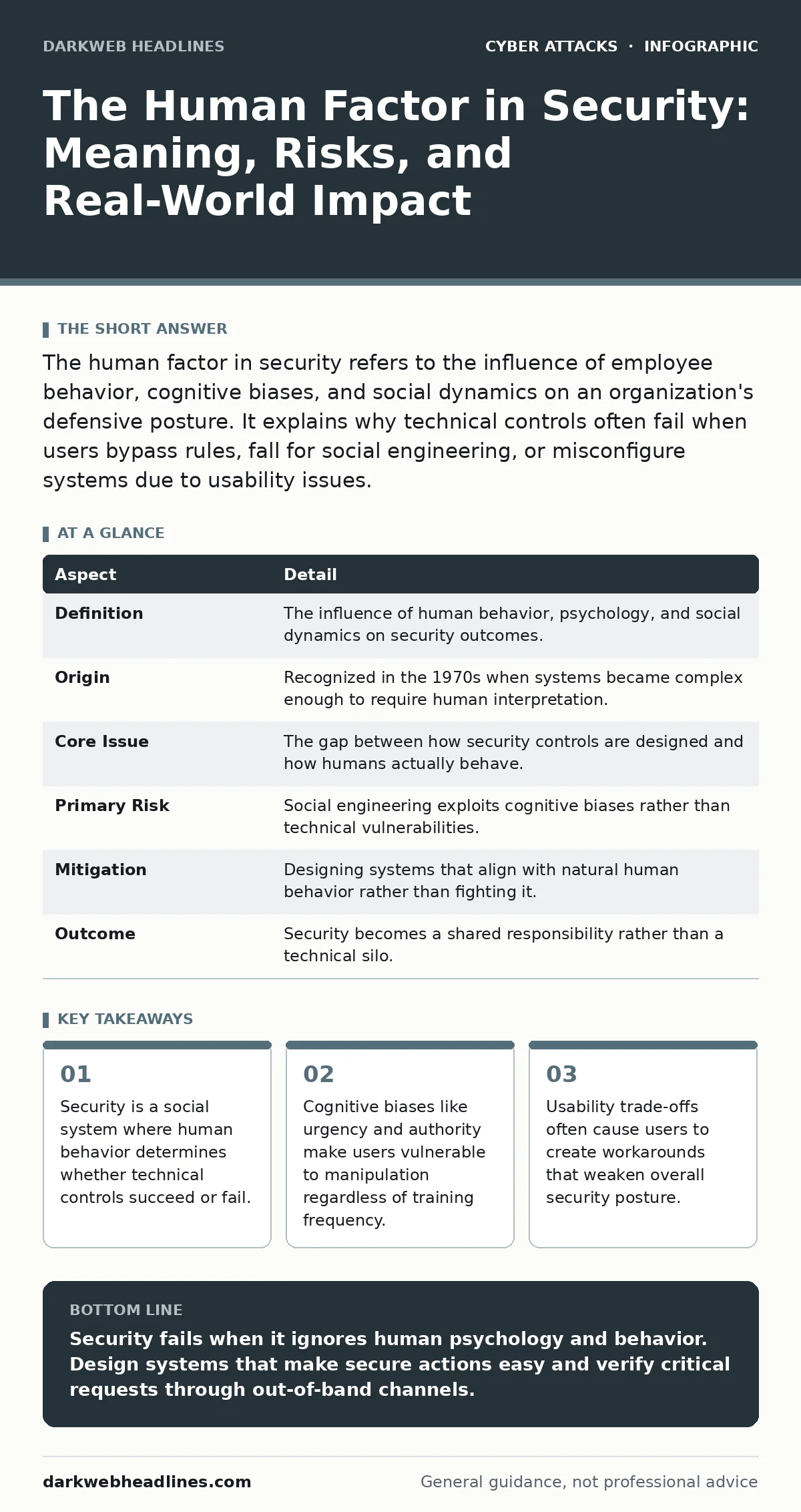
The human factor in security refers to the influence of employee behavior, cognitive biases, and social dynamics on an organization's defensive posture. It explains why technical controls often fail when users bypass rules, fall for social engineering, or misconfigure systems due to usability issues.
The Coffee Shop Analogy
Imagine a coffee shop with a heavy steel door. The lock is complex, requiring a key card and a four-digit PIN. The door is technically secure. However, if a regular customer holds the door open for a stranger who walks in behind them, the lock becomes irrelevant. The barrier was never the door; it was the human decision to allow tailgating.
In cybersecurity, this dynamic is known as the human factor. It is the study of how people interact with security systems. You cannot separate the technology from the person using it. The system only exists as a collection of human choices.
Most organizations invest heavily in firewalls and encryption. They treat the human element as an afterthought. This approach fails because humans are not machines. You do not process inputs with perfect logic. You act on habit, emotion, and social cues.
| Aspect | Detail |
|---|---|
| Definition | The influence of human behavior, psychology, and social dynamics on security outcomes. |
| Origin | Recognized in the 1970s when systems became complex enough to require human interpretation. |
| Core Issue | The gap between how security controls are designed and how humans actually behave. |
| Primary Risk | Social engineering exploits cognitive biases rather than technical vulnerabilities. |
| Mitigation | Designing systems that align with natural human behavior rather than fighting it. |
| Outcome | Security becomes a shared responsibility rather than a technical silo. |
Where the Term Comes From
The concept emerged when engineers realized that complex systems failed not because of bugs, but because of operator error. Early computer systems required manual input and monitoring. A tired operator might skip a verification step. A hurried operator might ignore a warning.
These were not moral failures. They were predictable responses to pressure and fatigue. The field of human factors engineering grew from this observation. It applied psychology and ergonomics to system design.
In security, this means looking at the user experience. If a security control is difficult to use, you will bypass it. If a warning message is confusing, you will ignore it. The term describes the intersection of psychology and technology. It acknowledges that you are part of the attack surface.
Daily Usage in Security Operations
You encounter the human factor every time you log in. A password policy requires complex characters. You write them down on a sticky note because you cannot remember them. The technical control is strong. The human behavior weakens it.
Security teams use this lens to analyze incidents. When a breach occurs, they look beyond the code. They ask how the user was convinced to act. They examine the workflow that led to the mistake. They study the environment that encouraged risky behavior.
This perspective changes how you build defenses. Instead of just adding more filters, you design for human error. You assume mistakes will happen. You build systems that recover gracefully. You reduce the friction of doing the right thing.
Common Misconceptions About Human Risk
Many believe that training solves the human factor. They assume that if you teach people enough, they will stop making mistakes. This is incorrect. Training increases knowledge, but it does not change instinct.
Under stress, people revert to habit. If the habit is clicking links quickly, training will not stop them. You cannot train away cognitive biases. You can only design systems that account for them.
Another mistake is viewing users as the weakest link. This language is unhelpful and inaccurate. Users are the most adaptable part of the system. They can also be the strongest defense. When empowered with good tools, they detect anomalies that machines miss.
The problem is not the human. The problem is the mismatch between the control and the human. You must design for the reality of human behavior, not the ideal.
The Psychology of Compliance
Security controls often rely on willpower. They ask you to remember complex rules. They ask you to resist immediate gratification. This is a losing battle. The human brain seeks efficiency. It seeks to reduce cognitive load.
When a security measure adds friction, you will find a way around it. You will reuse passwords. You will share credentials. You will disable warnings. These are rational responses to poor design.
Effective security aligns with natural behavior. It makes the secure choice the easy choice. It reduces the steps required to comply. It provides immediate feedback. It removes the need for constant vigilance.
Consider passkeys. They replace passwords with cryptographic keys. You do not need to remember them. You do not need to type them. You simply authenticate with biometrics or a device. This removes the human factor of memory and typing errors. It shifts the burden to the device, which is better at holding secrets.
Social Engineering and Cognitive Biases
Attackers do not hack code. They hack you. They use social engineering to trigger specific psychological responses. They exploit trust, fear, and curiosity.
Clone phishing is a common technique. An attacker takes a legitimate email you recently received. They change the attachment or link. They resend it with the same subject line. Because you recognize the context, you lower your guard. The technical signature may differ, but the social context is identical.
Angler phishing targets support channels. Attackers pose as customer service representatives on social media. They wait for you to complain about an issue. They offer help. They gain your trust. Then they ask for credentials. The interaction feels legitimate because it is personalized and responsive.
These attacks work because they bypass technical filters. They rely on your willingness to help or your desire for resolution. No firewall can stop a conversation. You must understand the psychology to recognize the manipulation.
Designing for Human Reality
You must accept that errors will occur. The goal is not to eliminate human error. The goal is to limit its impact. This requires a shift in design philosophy.
Start by reducing complexity. Fewer rules are easier to follow. Simple systems are easier to understand. Complex systems invite shortcuts.
Next, provide clear feedback. When you make a mistake, the system should tell you why. It should guide you to the correct action. It should not just block you.
Finally, verify critical actions. Callback verification is a simple but effective control. If a request seems unusual, call the person using a known number. Do not use the number in the email. This breaks the chain of social engineering. It adds a step, but it confirms identity.
The Role of Automation
Automation reduces the human factor by removing human steps. When you automate routine tasks, you reduce the chance of error. You also reduce the cognitive load on staff.
Secure email gateways filter malicious content before it reaches the inbox. This removes the need for you to spot every threat. It handles the volume. It allows you to focus on the exceptions.
However, automation has limits. It cannot understand context. It cannot judge intent. It can create a false sense of security. You must still monitor the system. You must still verify unusual patterns.
The best security combines automation with human judgment. Machines handle the scale. Humans handle the nuance. This division of labor is sustainable. It respects the strengths of both.
Beyond the Network Perimeter
The human factor extends beyond email and passwords. It affects network configuration and infrastructure.
ARP spoofing attacks rely on the trust inherent in local network protocols. An attacker sends false address resolution protocol messages. They link their MAC address to the IP address of a legitimate device. Traffic is redirected through the attacker.
This attack succeeds because the protocol assumes trust. It does not verify identity. Humans often misconfigure network segments, allowing this traffic to flow. Proper segmentation limits the damage. It contains the breach.
BGP hijacking is a larger-scale version. It manipulates the routing table of the internet. An attacker announces they own an IP address range. Traffic is diverted to their servers. This requires access to network infrastructure. It often involves human error in configuration or verification.
These examples show that the human factor is everywhere. It is in the code, the config, and the culture. You must look for it in every layer.
Key takeaways
- Security is a social system where human behavior determines whether technical controls succeed or fail.
- Cognitive biases like urgency and authority make users vulnerable to manipulation regardless of training frequency.
- Usability trade-offs often cause users to create workarounds that weaken overall security posture.
Security fails when it ignores human psychology and behavior. Design systems that make secure actions easy and verify critical requests through out-of-band channels.
Frequently asked questions
Is the human factor the same as social engineering?
No. Social engineering is a tactic used to exploit the human factor. The human factor is the broader study of how human behavior affects security outcomes, including errors, biases, and usability issues.
Can training eliminate the human factor?
Training cannot eliminate human error or cognitive biases. It can raise awareness, but humans will still react to stress and social cues. Design must account for these inevitable behaviors.
How do passkeys help with the human factor?
Passkeys remove the need to remember and type complex passwords. This eliminates errors related to memory and typing. It shifts the security burden to the device, which is more reliable at storing secrets.
What is the difference between clone phishing and angler phishing?
Clone phishing copies a specific email you have seen before to mimic context. Angler phishing involves attackers posing as support staff in public forums to build trust over time before stealing credentials.
How this guide was produced: written by the DarkWeb Headlines editorial team with AI assistance, checked against the public references listed below, and reviewed when the facts change. See our editorial policy or report an error.