Callback Verification Best Practices for Secure Identity Proofing
Callback verification shifts trust from static data to dynamic behavior, exposing flaws in automated fraud detection that rely solely on historical records.

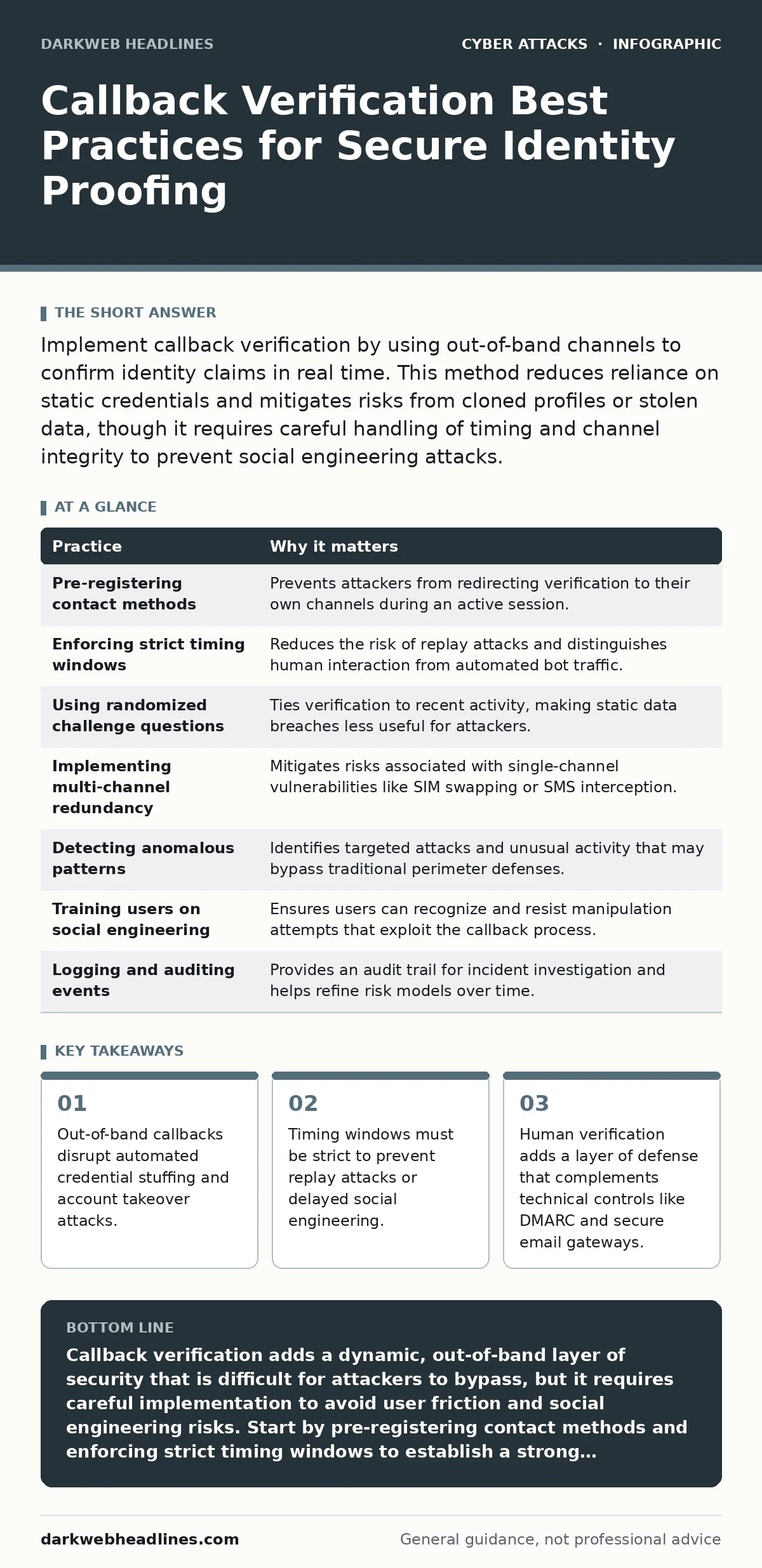
Implement callback verification by using out-of-band channels to confirm identity claims in real time. This method reduces reliance on static credentials and mitigates risks from cloned profiles or stolen data, though it requires careful handling of timing and channel integrity to prevent social engineering attacks.
The Mechanics of Out-of-Band Verification
Callback verification is a process where a system initiates a communication through a secondary channel to confirm a user’s identity or intent. Instead of relying on a password or a one-time code sent to the primary device, the system calls a pre-registered number or sends a message to a trusted contact. This method introduces a dynamic element that is difficult for attackers to replicate without physical access or sophisticated social engineering.
The core strength lies in the separation of channels. An attacker who has stolen your login credentials does not necessarily have access to your voice call history or your trusted contacts list. By forcing the verification to occur in a different domain, you create a barrier that static data breaches cannot easily cross. This is particularly effective against clone phishing, where attackers replicate legitimate interfaces to harvest credentials in real time.
1. Pre-Registering Contact Methods
The first step in any callback strategy is establishing the trusted channel before a security event occurs. You must register the phone number or secondary email address during the initial account setup or a known-good session. This prevents an attacker from intercepting a verification request by changing the contact details in the middle of a login attempt.
If you allow users to update their callback method during a session that requires verification, you create a race condition. The attacker could change the number to their own and then request the callback, trapping the legitimate user out of their account. Pre-registration ensures that the verification path is established when you are confident of the user’s identity.
Tip: Require a secondary factor, such as a hardware token or a biometric scan, before allowing any changes to callback contact information.
2. Enforcing Strict Timing Windows
Verification requests must have a short expiration time, typically between one and five minutes. This limit reduces the window in which an attacker can intercept the callback or coerce the user into responding. Longer windows increase the likelihood of replay attacks, where an attacker records a valid verification response and reuses it later.
Strict timing also helps distinguish between automated bot traffic and human interaction. Bots often operate in bursts and may not be able to complete a real-time callback within a narrow window. By enforcing tight deadlines, you add friction that slows down automated attacks while remaining manageable for legitimate users.
Tip: Display a countdown timer on the screen during the callback process to create urgency and reduce the chance of user distraction or delayed response.
3. Using Randomized Challenge Questions
Instead of asking the user to confirm a static fact, such as their last name or date of birth, use randomized challenge questions derived from recent account activity. For example, ask the user to confirm the last three digits of a recent transaction or the city from which they last logged in. This ensures that the verification is tied to recent, verifiable actions rather than static data that may have been leaked.
Static questions are vulnerable to data breaches and social media scraping. Randomized challenges require the attacker to have real-time access to the account’s activity, which is significantly harder to achieve. This approach aligns with the principles of the human factor in security, where context-aware verification reduces reliance on memorized secrets.
Tip: Ensure that the challenge questions do not reveal sensitive information to potential eavesdroppers or shoulder surfers.
4. Implementing Multi-Channel Redundancy
Relying on a single callback channel, such as SMS, leaves you vulnerable to SIM swapping and network interception. Implementing multi-channel redundancy allows the system to fall back to a secondary method, such as a voice call or an authenticator app, if the primary channel fails or is suspected to be compromised. This redundancy ensures that legitimate users are not locked out while maintaining security against channel-specific attacks.
Different channels have different threat profiles. SMS is convenient but vulnerable to interception, while voice calls are harder to automate but may be subject to social engineering. By using multiple channels, you can distribute the risk and make it harder for an attacker to compromise all paths simultaneously.
Tip: Allow users to prioritize their preferred callback channels during setup, but enforce a secondary method for high-risk transactions.
5. Detecting Anomalous Callback Patterns
Monitor the frequency and timing of callback requests to detect unusual patterns. A sudden spike in callbacks for a single account or from a specific geographic location may indicate a targeted attack. Anomaly detection systems can flag these events for manual review or additional verification steps, preventing automated attacks from succeeding.
This practice complements other security measures, such as DMARC, which protects email authentication, and secure email gateways, which filter malicious content. By analyzing callback patterns, you can identify attacks that bypass traditional perimeter defenses and target the identity layer directly.
Tip: Set alerts for callbacks that occur outside of the user’s typical activity hours or from unfamiliar devices.
6. Training Users on Social Engineering Risks
Callback verification is only as strong as the user’s ability to recognize and resist social engineering attacks. Attackers may impersonate support staff or use urgency to trick users into revealing verification codes or confirming fraudulent requests. Training users to recognize these tactics is critical to maintaining the integrity of the callback process.
Users should be taught to independently verify the source of any callback request. If a caller claims to be from your organization, the user should hang up and call the official support number listed on your website. This practice prevents attackers from leveraging trust in the callback mechanism to gain unauthorized access.
Tip: Include callback verification scenarios in regular security awareness training to reinforce best practices.
7. Logging and Auditing Callback Events
Every callback request and response should be logged with detailed metadata, including timestamps, IP addresses, and device identifiers. These logs provide an audit trail that can be used to investigate security incidents and improve the verification process over time. Regular audits help identify weaknesses in the callback system and ensure compliance with security standards.
Logging also helps in detecting insider threats or compromised accounts. By analyzing callback logs, you can identify patterns that suggest unauthorized access or misuse of the verification system. This data is valuable for refining risk models and enhancing the overall security posture.
Tip: Ensure that logs are stored securely and accessed only by authorized personnel to protect user privacy.
| Practice | Why it matters |
|---|---|
| Pre-registering contact methods | Prevents attackers from redirecting verification to their own channels during an active session. |
| Enforcing strict timing windows | Reduces the risk of replay attacks and distinguishes human interaction from automated bot traffic. |
| Using randomized challenge questions | Ties verification to recent activity, making static data breaches less useful for attackers. |
| Implementing multi-channel redundancy | Mitigates risks associated with single-channel vulnerabilities like SIM swapping or SMS interception. |
| Detecting anomalous patterns | Identifies targeted attacks and unusual activity that may bypass traditional perimeter defenses. |
| Training users on social engineering | Ensures users can recognize and resist manipulation attempts that exploit the callback process. |
| Logging and auditing events | Provides an audit trail for incident investigation and helps refine risk models over time. |
Integrating with Broader Security Frameworks
Callback verification does not exist in a vacuum. It must be integrated with other security controls to provide a layered defense. For instance, while callback verification protects against credential theft, it does not protect against session hijacking, where an attacker steals an active session token. Combining callback verification with session management best practices ensures that even if a session is compromised, the attacker cannot easily reset credentials or change account settings.
Similarly, callback verification complements CAPTCHA systems by adding a human-centric verification step that is difficult for bots to automate. While CAPTCHA prevents automated form submissions, callback verification ensures that the person submitting the form is who they claim to be. This dual approach addresses both automated and human-led threats.
The Hidden Costs of Friction
Implementing callback verification introduces friction into the user experience. Users may find the process inconvenient, especially if they are in areas with poor network coverage or if the callback fails due to technical issues. This friction can lead to increased support costs and user frustration, which must be balanced against the security benefits.
To mitigate these costs, ensure that the callback process is as seamless as possible. Use clear instructions, provide multiple fallback options, and minimize the time required for verification. Regularly review user feedback and support tickets to identify and address pain points in the callback process.
Key takeaways
- Out-of-band callbacks disrupt automated credential stuffing and account takeover attacks.
- Timing windows must be strict to prevent replay attacks or delayed social engineering.
- Human verification adds a layer of defense that complements technical controls like DMARC and secure email gateways.
Callback verification adds a dynamic, out-of-band layer of security that is difficult for attackers to bypass, but it requires careful implementation to avoid user friction and social engineering risks. Start by pre-registering contact methods and enforcing strict timing windows to establish a strong foundation for identity proofing.
Frequently asked questions
How does callback verification differ from two-factor authentication?
Two-factor authentication typically uses something you know (password) and something you have (device), while callback verification adds a third layer by confirming identity through a separate, out-of-band channel like a voice call or trusted contact.
Can callback verification prevent all types of account takeover attacks?
No, it significantly reduces the risk but does not eliminate it. Attackers may still use social engineering or SIM swapping to bypass callback verification, so it should be part of a broader security strategy.
How this guide was produced: written by the DarkWeb Headlines editorial team with AI assistance, checked against the public references listed below, and reviewed when the facts change. See our editorial policy or report an error.