Bug Bounty Programs Explained: How Ethical Hacking Works
Bug bounty programs turn security testing into a market where independent researchers earn rewards for finding flaws before malicious actors exploit them.

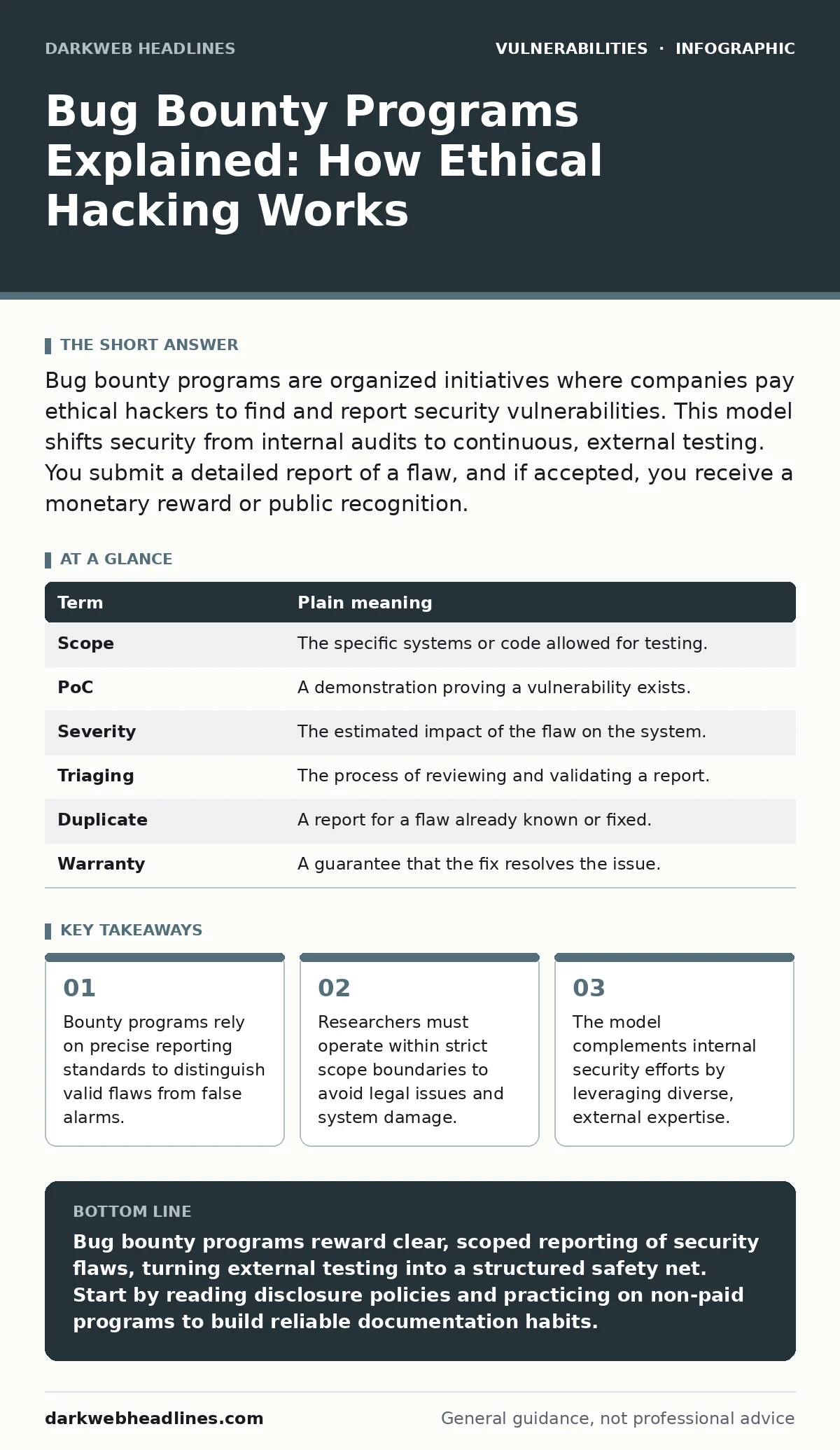
Bug bounty programs are organized initiatives where companies pay ethical hackers to find and report security vulnerabilities. This model shifts security from internal audits to continuous, external testing. You submit a detailed report of a flaw, and if accepted, you receive a monetary reward or public recognition.
The Library Inspection Analogy
Imagine a large public library that relies on its own staff to check for loose floorboards or broken locks. The staff knows the building well, but they might miss hidden dangers because they see the same things every day. Now suppose the library invites independent inspectors to walk through the halls. These inspectors look for problems with fresh eyes. If they find a tripping hazard, they report it to the head librarian. In return, the library gives them a small reward for keeping patrons safe. This is the core mechanic of a bug bounty program. The library represents the software company. The inspectors are the security researchers. The reward is the bounty.
Defining the Participants
In this model, the company sets the rules. They define which systems are fair game. This boundary is called the scope. It lists the specific domains, applications, or IP addresses that researchers may test. Testing outside this scope is forbidden. It can be considered unauthorized access, which carries legal risk. The researcher is often called a bug hunter or white-hat hacker. They use their skills to find weaknesses in the code or configuration. When they find a flaw, they do not exploit it for gain. They document it and submit it to the company.
The Mechanics of Reporting
Finding a flaw is only half the work. You must prove it exists without causing harm. This proof is called a proof of concept or PoC. A PoC demonstrates that the vulnerability is real and exploitable. It might be a simple script or a step-by-step manual instruction. The company reviews the submission. They check if the flaw is new and if it matches the scope. If it is valid, they assign a severity level. Severity determines the payout. High-severity flaws, such as remote code execution, pay more. Low-severity issues, like minor information disclosure, pay less.
| Term | Plain meaning |
|---|---|
| Scope | The specific systems or code allowed for testing. |
| PoC | A demonstration proving a vulnerability exists. |
| Severity | The estimated impact of the flaw on the system. |
| Triaging | The process of reviewing and validating a report. |
| Duplicate | A report for a flaw already known or fixed. |
| Warranty | A guarantee that the fix resolves the issue. |
The Hidden Cost of Ambiguity
Many beginners focus only on finding bugs. They neglect the writing. A vague report causes delays. If the triage team cannot reproduce your finding, they may close it as "invalid". This wastes your time and theirs. You must write clearly. Include exact steps to reproduce the issue. Show the impact. Explain why it matters. This clarity speeds up the fix. It also builds your reputation. Good researchers are invited to private programs. Private programs have fewer hunters and higher rewards. But they require trust. Trust is earned through clear, accurate reporting.
Navigating Severity and Standards
Severity is not just about money. It is about risk. Companies use frameworks to standardize this. You will often see references to CWE weakness categories. These categories classify common software weaknesses. For example, a broken access control is one category. A cross-site scripting flaw is another. Understanding these categories helps you describe your finding accurately. It also helps the triage team understand the risk. Some flaws are complex. They might involve XML external entity (XXE) attacks. These are older but still dangerous flaws in data processing. Knowing the underlying mechanism helps you explain the danger.
See also: Malicious Typosquatted Packages: 7 Mistakes That Invite Supply Chain Attacks · TOCTOU Bugs: 7 Mistakes That Leave Your Code Open to Race Conditions
The Edge Case of Scope
Scope definitions can be tricky. Sometimes a company lists a domain like *.example.com. This might include development servers. Testing a development server can crash it. It might delete data. This is bad practice. Always assume production-like systems are fragile. If you are unsure, ask. Most platforms allow you to message the program manager. Clarifying scope prevents accidents. It also prevents legal trouble. Unauthorized testing is a crime. Staying in scope is your legal shield. Do not assume that because a system is public, it is fair game.
Your First Practical Steps
You do not need to be an expert to start. You need discipline. Follow these steps to begin your journey.
- Read the policy. Every program has a disclosure policy. It tells you how to submit and what is allowed. Ignore this at your peril.
- Start with VDPs. Vulnerability Disclosure Programs (VDPs) do not pay money. They offer kudos or points. They are less competitive. They are ideal for practice. You can learn the process without pressure.
- Document everything. Keep notes on your testing. Record your steps. Save screenshots. This evidence supports your claim. It makes triage faster.
Beyond the Bounty
Bug bounties are not a replacement for internal security. They are a supplement. Companies still run vulnerability management programs. These are internal processes for tracking and fixing flaws. They also release security advisories to inform users of risks. Sometimes, they wait for Patch Tuesday to deploy fixes. This coordinated approach reduces chaos. As a researcher, you are part of this ecosystem. You find the flaw. The company fixes it. The user stays safe. Understanding this flow helps you communicate better. You are not an adversary. You are a partner in security.
Key takeaways
- Bounty programs rely on precise reporting standards to distinguish valid flaws from false alarms.
- Researchers must operate within strict scope boundaries to avoid legal issues and system damage.
- The model complements internal security efforts by leveraging diverse, external expertise.
Bug bounty programs reward clear, scoped reporting of security flaws, turning external testing into a structured safety net. Start by reading disclosure policies and practicing on non-paid programs to build reliable documentation habits.
Frequently asked questions
What happens if I find a bug but do not report it?
You may face legal consequences for unauthorized access. Reporting is the only safe way to handle discovered flaws.
Can I test mobile apps in bug bounty programs?
Only if the scope explicitly includes mobile applications. Many programs focus on web only.
Is it legal to test a company without permission?
No. Testing without explicit permission is illegal. Always use authorized platforms or written consent.
How do I handle a duplicate report?
Accept the outcome gracefully. Use the feedback to improve your research skills.
How this guide was produced: written by the DarkWeb Headlines editorial team with AI assistance, checked against the public references listed below, and reviewed when the facts change. See our editorial policy or report an error.