Dark web threat intelligence mistakes and how to fix them
Treating hidden forum chatter as verified technical indicators often wastes precious analyst hours on dead ends.

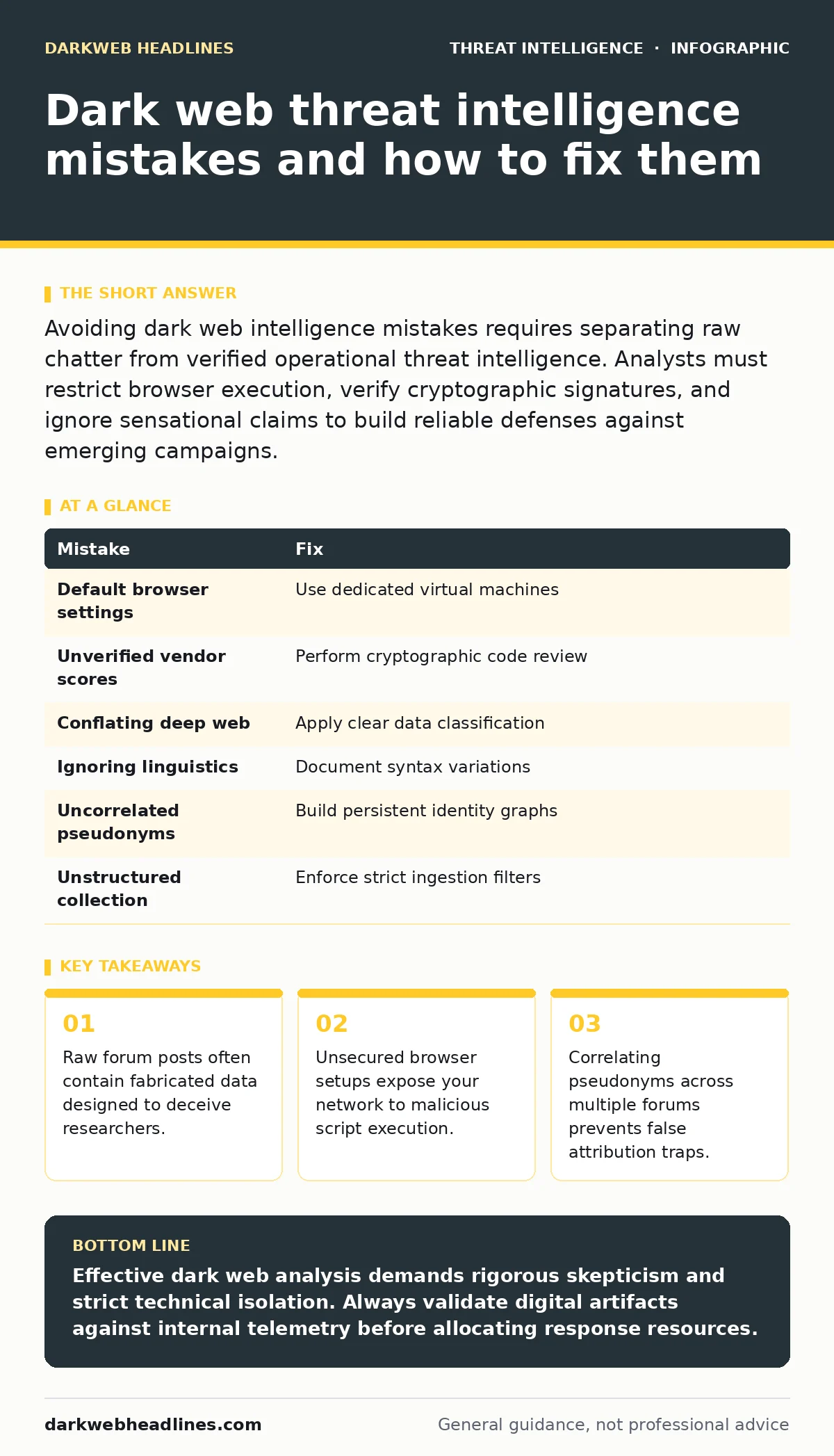
Avoiding dark web intelligence mistakes requires separating raw chatter from verified operational threat intelligence. Analysts must restrict browser execution, verify cryptographic signatures, and ignore sensational claims to build reliable defenses against emerging campaigns.
Mistake 1: Running default browser configurations on hidden networks
Why it hurts: Default browser settings permit executing active scripts that expose your real IP address and local machine architecture to hostile server operators. Adversaries monitor incoming connections for known configuration flaws, allowing them to fingerprint your hardware and map your internal network boundaries.
The fix: Strict isolation protocols require running browsing software inside dedicated virtual machines with all scripting capabilities disabled by default. Network administrators should route traffic through hardened gateways to ensure zero leakage of underlying telemetry data back to the hosting provider.
Mistake 2: Trusting unverified vendor reputations on illicit markets
Why it hurts: Reputation scores on hidden forums are easily manipulated through artificial positive reviews and coordinated sockpuppet accounts controlled by single entities. Relying on these metrics leads security teams to purchase fabricated exploit payloads or misinformation designed to misdirect internal investigations.
The fix: Independent cryptographic verification of sample code remains mandatory before assessing any threat. Analysts must test received artifacts in sandboxed environments to confirm functional reality rather than accepting seller claims at face value during routine investigations.
Mistake 3: Treating the deep web and hidden services as interchangeable
Why it hurts: Conflating unindexed databases with specialized encrypted networks obscures the actual origin of leaked assets. Misidentifying the source prevents teams from implementing proper access controls on exposed internal portals that require authentication rather than specialized routing software.
The fix: Clear data classification frameworks help distinguish between standard password-protected portals and encrypted overlay networks. Security teams must map asset visibility accurately to deploy appropriate defenses against unauthorized data harvesting operations conducted by external adversaries.
Mistake 4: Ignoring linguistic anomalies in forum posts
Why it hurts: Automated translation tools and disguise techniques often create unnatural phrasing that reveals the true geographic or organizational origin of threat actors. Dismissing these subtle textual patterns causes organizations to miss valuable context about who is actually targeting their sector.
The fix: Linguistic analysis combined with metadata evaluation helps uncover operational threat intelligence hidden within routine message boards. Researchers should document syntax variations alongside technical indicators to track specific author profiles over extended periods without relying solely on claimed identities.
Mistake 5: Failing to correlate pseudonyms across distinct platforms
Why it hurts: Treating each forum handle as a unique individual blinds analysts to broader campaigns orchestrated by single entities operating across multiple ecosystems. Shared writing habits or reuse of specific wallet addresses often link seemingly unrelated personas to major threat actor groups.
The fix: Centralized graphing tools allow security teams to map relationship nodes between different alias handles and communication channels. Establishing persistent identity graphs exposes hidden connections that isolated manual reviews consistently fail to identify during standard operational review cycles.
See also: Deep Web Intelligence: Why It Changes Security Decisions · Cyber Espionage Myths: Why State Actors Fail and How They Actually Operate
Mistake 6: Collecting high volumes of data without structured taxonomies
Why it hurts: Accumulating massive repositories of unindexed chatter creates overwhelming noise that paralyzes incident response teams during critical moments. Sifting through unstructured text archives wastes valuable hours that should be spent mitigating active command and control traffic on corporate networks.
The fix: Strict ingestion filters must prioritize actionable intelligence items that match specific threat profiles relevant to your organization. Database administrators should enforce strict tagging rules before storing external data for long-term analysis within secure enterprise repositories.
| Mistake | Fix |
|---|---|
| Default browser settings | Use dedicated virtual machines |
| Unverified vendor scores | Perform cryptographic code review |
| Conflating deep web | Apply clear data classification |
| Ignoring linguistics | Document syntax variations |
| Uncorrelated pseudonyms | Build persistent identity graphs |
| Unstructured collection | Enforce strict ingestion filters |
Key takeaways
- Raw forum posts often contain fabricated data designed to deceive researchers.
- Unsecured browser setups expose your network to malicious script execution.
- Correlating pseudonyms across multiple forums prevents false attribution traps.
Effective dark web analysis demands rigorous skepticism and strict technical isolation. Always validate digital artifacts against internal telemetry before allocating response resources.
Frequently asked questions
Can automated crawlers safely gather hidden forum data without human intervention?
Automated crawlers can collect large volumes of text, but they frequently fail to evaluate context, requiring human analysts to filter out noise and deliberate disinformation.
How do threat actors disguise their true identities on underground forums?
Adversaries frequently rotate pseudonyms, employ automated translation tools, and coordinate artificial reputation inflation to mislead researchers tracking their activities.
What is the primary risk of downloading sample files from illicit marketplaces?
Downloaded samples often contain secondary payloads designed to compromise analysis workstations or deploy tracking beacons back to the seller.
Why is technical attribution difficult on encrypted overlay networks?
The absence of reliable metadata and the widespread use of shared infrastructure make definitive attribution nearly impossible without corroborating internal telemetry.
How this guide was produced: written by the DarkWeb Headlines editorial team with AI assistance, checked against the public references listed below, and reviewed when the facts change. See our editorial policy or report an error.