Cyber Range Training Platforms and How They Work
Simulated networks let security operators practice defending real infrastructure against attacks without risking operational downtime.

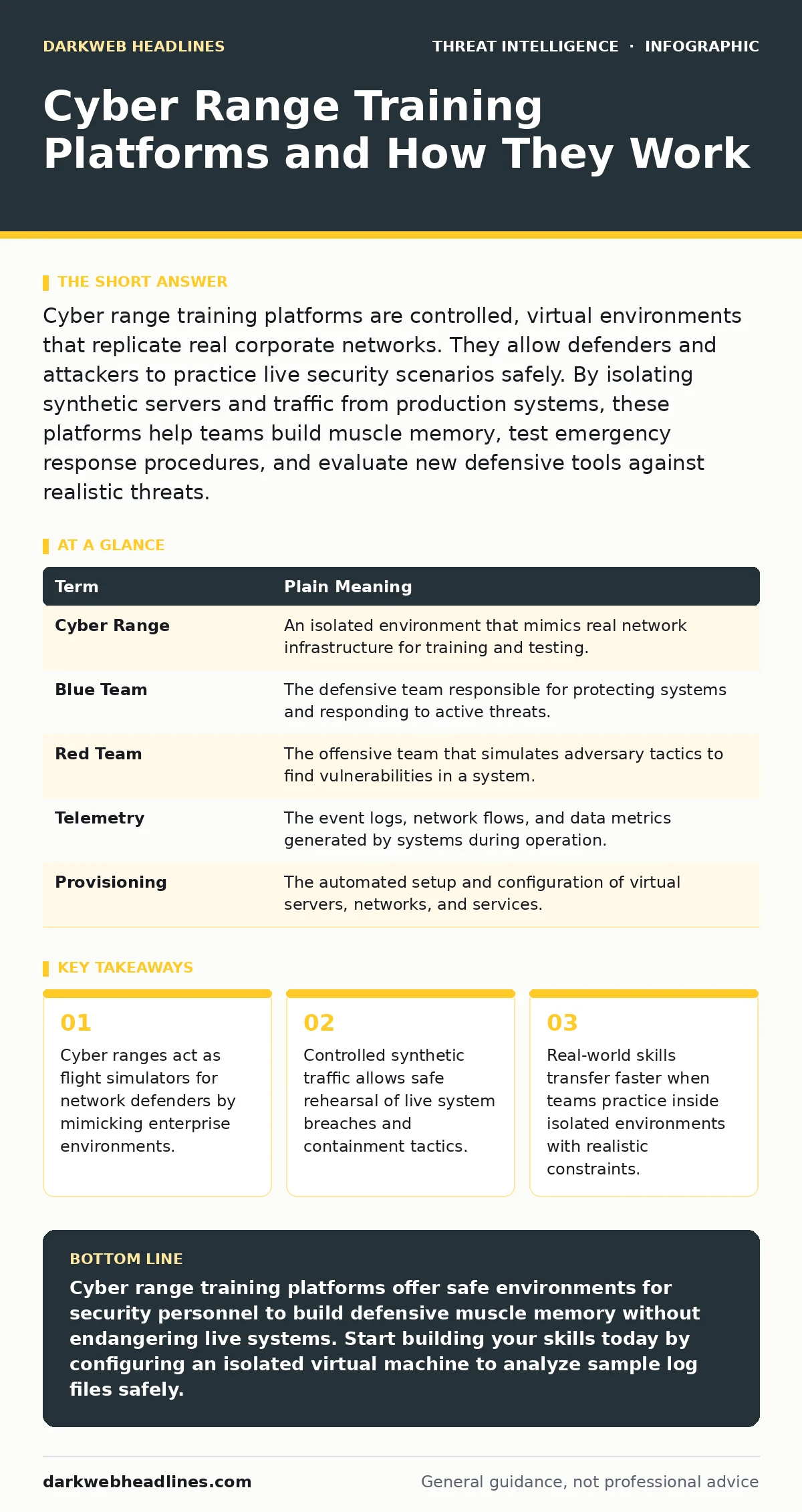
Cyber range training platforms are controlled, virtual environments that replicate real corporate networks. They allow defenders and attackers to practice live security scenarios safely. By isolating synthetic servers and traffic from production systems, these platforms help teams build muscle memory, test emergency response procedures, and evaluate new defensive tools against realistic threats.
How Does a Flight Simulator Explain Cyber Ranges?
Cyber range training platforms operate like flight simulators designed for network administrators and security analysts. Imagine a pilot learning to handle engine failure during a storm. Practicing that emergency in a live commercial flight puts passengers at risk, whereas a cockpit simulator reproduces turbulence, system failures, and poor visibility without dangerous consequences.
A cyber range creates that same realistic environment for computer networks. It provisions virtual machines, fake user accounts, and synthetic traffic to mirror a real organization. Security personnel can observe attacks, misconfigure firewalls, or execute risky remediation commands without taking down corporate operations or exposing sensitive database records to destruction.
What Key Terms Define Synthetic Environments?
| Term | Plain Meaning |
|---|---|
| Cyber Range | An isolated environment that mimics real network infrastructure for training and testing. |
| Blue Team | The defensive team responsible for protecting systems and responding to active threats. |
| Red Team | The offensive team that simulates adversary tactics to find vulnerabilities in a system. |
| Telemetry | The event logs, network flows, and data metrics generated by systems during operation. |
| Provisioning | The automated setup and configuration of virtual servers, networks, and services. |
Security teams often evaluate operational threat intelligence inside these environments to see how emerging adversary tactics interact with their existing security stack.
Why Do Security Teams Train in Isolated Environments?
Practicing security response inside a active production network creates severe business risks. A misplaced command intended to block an attacker can accidentally sever connectivity for thousands of legitimate customers. Simulated platforms eliminate this operational hazard by decoupling training exercises from live business systems.
These isolated networks allow security teams to practice executing SOC playbooks under realistic pressure. Analysts learn how to read raw log events, detect abnormal administrative commands, and coordinate communication across departments while an attack unfolds.
How Does Training in a Range Protect Ordinary Users?
Ordinary computer users benefit directly when enterprise security staff practice incident containment inside synthetic environments. When defenders refine their skills in a simulator, they stop real network intrusions faster, preventing the unauthorized exposure of personal files, financial records, and login credentials.
Simulated training also prepares defenders against operational disruptions like ransomware infections. When analysts practice identifying lateral movement techniques, such as PowerShell abuse, they can isolate infected workstations before critical services go offline, ensuring everyday digital services remain reliable.
What Simple Steps Can You Take Right Now?
- Set up a local virtual machine using free, open-source hypervisor software to run isolated test operating systems safely.
- Practice analyzing sample packet captures and system event logs to learn what normal background network traffic looks like.
- Review standard security incident response frameworks to understand how technical teams categorize, contain, and remediate system compromises.
See also: Initial Access Broker Response: Containment and Recovery Steps · How SOC Playbooks Work: Mechanism, Limits, and Execution
What Are the Hidden Trade-Offs of Synthetic Platforms?
Simulated training environments can create a false sense of security if the platform relies on overly predictable attack scripts. Real adversaries do not follow fixed paths; they improvise, pause for days, or abandon noisy techniques when they notice active monitoring.
Setting up high-fidelity environments requires significant computing infrastructure and maintenance. Teams that feed threat intelligence feeds into their range must constantly update their scenario topologies, or the simulator quickly becomes an accurate model of past risks rather than present threats.
Security groups studying hacktivism scenarios often find that simulated platforms struggle to replicate the sheer volume of distributed traffic generated during chaotic public campaigns.
What Non-Obvious Lessons Emerge From Range Data?
Data collected during range exercises reveals that technical misconfigurations cause failure more often than complex zero-day exploits. Defenders frequently miss ongoing attacks not because their software failed, but because they turned off intrusive monitoring alerts to eliminate overwhelming background noise.
Another counterintuitive insight involves physical fatigue during prolonged simulated breaches. Analysts who make sound decisions during the first hour of an incident often commit critical syntax errors during the fourth hour, demonstrating that operational endurance matters as much as technical knowledge.
Simulators also highlight how reliance on defensive traps, such as honeypots, can distract defenders if those lures are not integrated into an automated alerting strategy.
Key takeaways
- Cyber ranges act as flight simulators for network defenders by mimicking enterprise environments.
- Controlled synthetic traffic allows safe rehearsal of live system breaches and containment tactics.
- Real-world skills transfer faster when teams practice inside isolated environments with realistic constraints.
Cyber range training platforms offer safe environments for security personnel to build defensive muscle memory without endangering live systems. Start building your skills today by configuring an isolated virtual machine to analyze sample log files safely.
Frequently asked questions
What is a cyber range training platform?
A cyber range training platform is a virtual environment that replicates computer networks so security professionals can practice offensive and defensive skills safely. It isolates exercises from live infrastructure to prevent accidental system downtime.
How do cyber ranges differ from traditional online labs?
Cyber ranges simulate full network topologies with dynamic background traffic and interdependent servers rather than isolated single-purpose challenges. They allow multiple participants to act as opposing teams in real time.
Do beginners need advanced coding skills to use a cyber range?
Beginners do not need advanced coding skills to start basic exercises in a cyber range. Most foundational modules focus on operating system navigation, log analysis, and basic network traffic observation.
Can cyber ranges simulate real adversary tactics safely?
Cyber ranges simulate real adversary tactics safely by executing offensive tools inside sandboxed virtual networks isolated from the public internet. This design keeps live corporate systems completely safe during destructive attack scenarios.
How this guide was produced: written by the DarkWeb Headlines editorial team with AI assistance, checked against the public references listed below, and reviewed when the facts change. See our editorial policy or report an error.