7 API Security Mistakes That Leave Systems Open to Abuse
Most API breaches occur not from external hacking but from internal misconfigurations that allow attackers to manipulate data logic without ever breaking authentication.

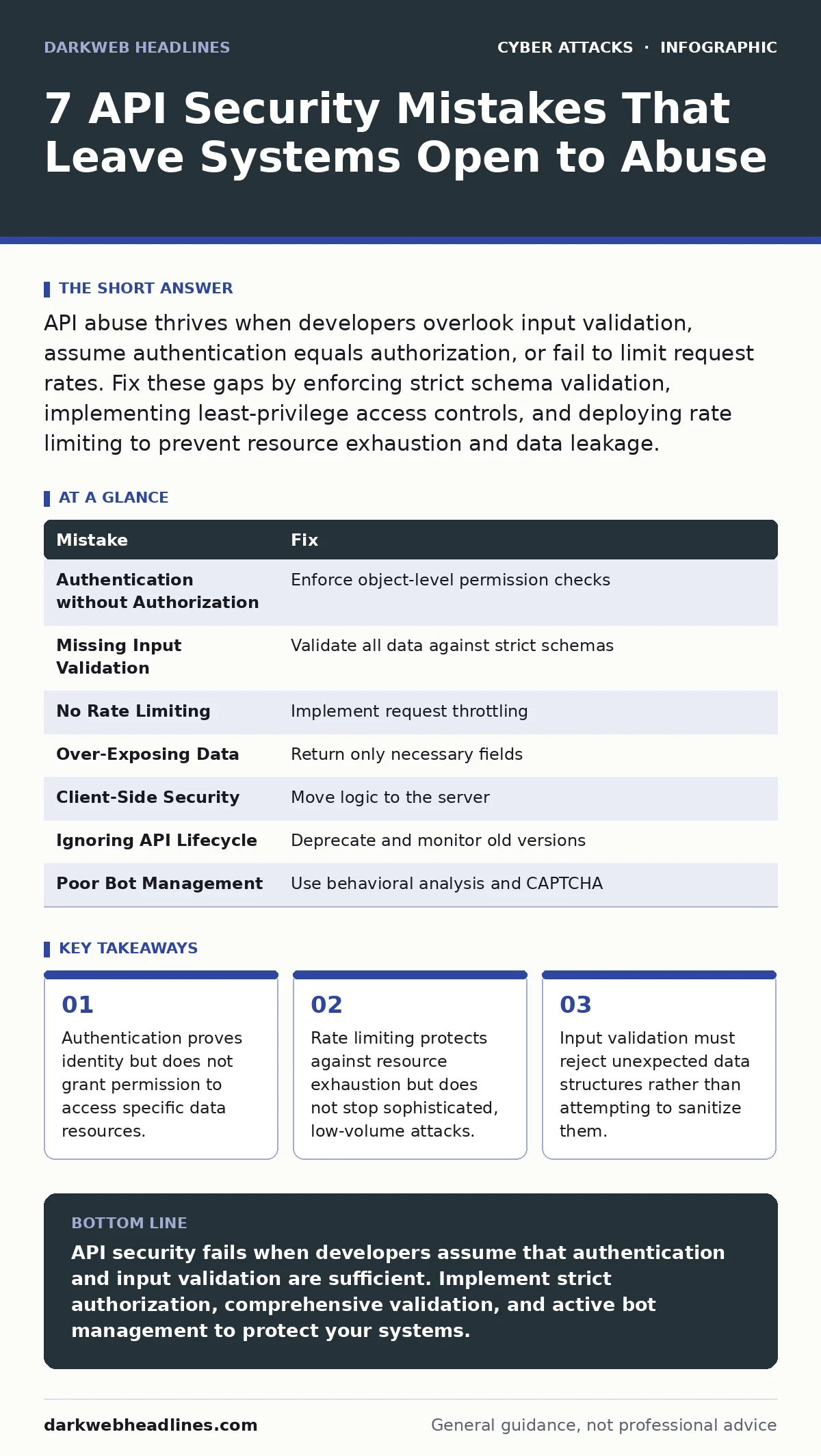
API abuse thrives when developers overlook input validation, assume authentication equals authorization, or fail to limit request rates. Fix these gaps by enforcing strict schema validation, implementing least-privilege access controls, and deploying rate limiting to prevent resource exhaustion and data leakage.
Mistake 1: Assuming Authentication Equals Authorization
Authentication verifies who a user is, while authorization determines what that user can do. Many APIs authenticate a request successfully but then fail to check if the authenticated user has permission to access the specific resource requested. This gap allows an attacker with valid credentials to access data belonging to other users or perform administrative actions they are not allowed to execute.
Why it hurts:
Attackers exploit this by manipulating identifiers in API requests, such as changing a user ID in a URL or JSON payload. If the API only checks for a valid session token but does not verify ownership of the target resource, the attacker gains unauthorized access. This leads to sensitive data exposure and potential data manipulation.
The fix:
Implement object-level authorization checks on every request. The server must verify that the authenticated user owns or has explicit permission to access the specific resource identified in the request. Never rely solely on the presence of a valid token or session to grant access.
Mistake 2: Ignoring Input Validation on All Data
Developers often validate user-facing inputs but neglect to validate data received from other internal services or trusted partners. They assume that because the source is internal, the data is safe. This trust boundary violation allows malicious payloads to enter the system through indirect paths, bypassing perimeter defenses.
Why it hurts:
Invalid or malicious data can cause the application to behave unexpectedly, crash, or execute unintended code. If an API accepts unexpected data types or formats, it may process them in ways that reveal system details or allow injection attacks. This weakens the entire security posture of the application.
The fix:
Validate all incoming data against a strict schema, regardless of the source. Reject any request that does not conform to the expected format, type, and length. Use allowlists for acceptable values rather than blocklists for known bad patterns. This approach ensures that only known-good data enters the processing pipeline.
Mistake 3: Failing to Limit Request Rates
APIs are often designed to handle high volumes of legitimate traffic, but they lack mechanisms to distinguish between normal usage and abusive behavior. Without rate limiting, a single user can send thousands of requests per second, consuming server resources and degrading performance for all other users.
Why it hurts:
Attackers exploit this to launch denial-of-service attacks or to brute-force guess sensitive information, such as passwords or API keys. Even if the API is protected against traditional Slowloris attacks, high-volume request floods can still overwhelm the application layer. This leads to service outages and increased infrastructure costs.
The fix:
Implement rate limiting at both the API gateway and the application level. Define thresholds for requests per minute, hour, or day, and enforce them consistently. Return clear error messages when limits are exceeded, but avoid revealing details about the system’s internal state. This protects resources and discourages automated abuse.
Mistake 4: Exposing Sensitive Data in Responses
APIs often return more data than the client actually needs. Developers may include internal identifiers, debugging information, or full user profiles in the response payload for convenience. This over-exposure provides attackers with valuable information that can be used to craft more targeted attacks.
Why it hurts:
Excess data reveals the internal structure of the application and the relationships between different entities. Attackers can use this information to map the system, identify vulnerabilities, or escalate privileges. For example, including internal database IDs in responses can allow an attacker to infer the structure of the backend.
The fix:
Design API responses to return only the data strictly necessary for the client’s functionality. Strip out internal identifiers, debugging flags, and redundant fields. Use data masking techniques to hide sensitive information, such as partial credit card numbers or masked email addresses. This minimizes the attack surface and reduces the risk of data leakage.
Mistake 5: Relying on Client-Side Security Controls
Some applications place critical security logic on the client side, such as input validation or access control checks. Developers assume that because the code runs on the user’s device, it is secure. However, attackers can easily intercept, modify, or bypass client-side controls using browser developer tools or proxy servers.
Why it hurts:
Client-side controls are invisible to the server, which processes requests without verifying the client’s security checks. Attackers can send crafted requests that bypass these controls, leading to unauthorized actions or data manipulation. This undermines the entire security model of the application.
The fix:
Move all critical security logic to the server side. The server must enforce all validation, authorization, and access control checks independently of the client. Treat client-side controls as a convenience feature for user experience, not as a security mechanism. This ensures that security decisions are made in a trusted environment.
Mistake 6: Neglecting API Versioning and Deprecation
APIs evolve over time, but old versions are often left active without proper monitoring or security updates. Developers assume that deprecated versions are no longer in use, but legacy integrations or attackers may still interact with them. These older versions may contain known vulnerabilities that have been fixed in newer releases.
Why it hurts:
Deprecated API versions become low-hanging fruit for attackers. They often lack the latest security patches and may have weaker access controls. Attackers can exploit these vulnerabilities to gain unauthorized access or disrupt services. This creates a persistent risk that is difficult to mitigate without proper lifecycle management.
The fix:
Implement a clear API versioning strategy and enforce strict deprecation policies. Monitor usage of all API versions and notify clients when a version is approaching end-of-life. Disable old versions promptly after the deprecation period. This ensures that all active APIs receive consistent security updates and monitoring.
Mistake 7: Overlooking Bot Traffic Management
APIs are prime targets for automated bots that scrape data, submit fraudulent transactions, or probe for vulnerabilities. Many APIs lack mechanisms to distinguish between legitimate automated clients and malicious bots. This allows attackers to operate at scale without detection.
Why it hurts:
Malicious bot traffic can consume significant resources, distort analytics, and lead to financial losses. Unlike human users, bots can make thousands of requests in seconds, overwhelming the system. Without proper detection and mitigation, these attacks can go unnoticed for extended periods.
The fix:
Implement bot management solutions that analyze request patterns, user-agent strings, and behavioral characteristics. Use CAPTCHA challenges for suspicious requests to verify human interaction. Block known malicious IP addresses and user-agent strings. This helps filter out harmful automated traffic while allowing legitimate bots to operate.
| Mistake | Fix |
|---|---|
| Authentication without Authorization | Enforce object-level permission checks |
| Missing Input Validation | Validate all data against strict schemas |
| No Rate Limiting | Implement request throttling |
| Over-Exposing Data | Return only necessary fields |
| Client-Side Security | Move logic to the server |
| Ignoring API Lifecycle | Deprecate and monitor old versions |
| Poor Bot Management | Use behavioral analysis and CAPTCHA |
Key takeaways
- Authentication proves identity but does not grant permission to access specific data resources.
- Rate limiting protects against resource exhaustion but does not stop sophisticated, low-volume attacks.
- Input validation must reject unexpected data structures rather than attempting to sanitize them.
API security fails when developers assume that authentication and input validation are sufficient. Implement strict authorization, comprehensive validation, and active bot management to protect your systems.
Frequently asked questions
How do I detect if my API is being abused?
Monitor for unusual request patterns, such as high volumes of failed authentication attempts, requests from known malicious IP addresses, or unexpected spikes in data access. Analyze logs for anomalies that deviate from normal user behavior.
What is the difference between rate limiting and throttling?
Rate limiting blocks requests that exceed a defined threshold, while throttling slows down the processing of requests to manage load. Both techniques help protect resources, but rate limiting is more effective against brute-force attacks, while throttling helps maintain service stability.
Can API keys alone secure an API?
No, API keys provide basic authentication but do not enforce authorization or limit usage. They should be combined with other security measures, such as IP whitelisting, rate limiting, and encryption, to provide robust protection against abuse.
How often should I review API security configurations?
Review configurations regularly, especially after changes to the application or infrastructure. Conduct periodic security assessments and penetration testing to identify new vulnerabilities. Stay updated on emerging threats and adjust controls accordingly.
How this guide was produced: written by the DarkWeb Headlines editorial team with AI assistance, checked against the public references listed below, and reviewed when the facts change. See our editorial policy or report an error.