How SaaS Data Exposure Happens: The Step-by-Step Attack Chain
SaaS breaches rarely involve hacking the vendor; they exploit the gap between user identity, application permissions, and downstream data storage.

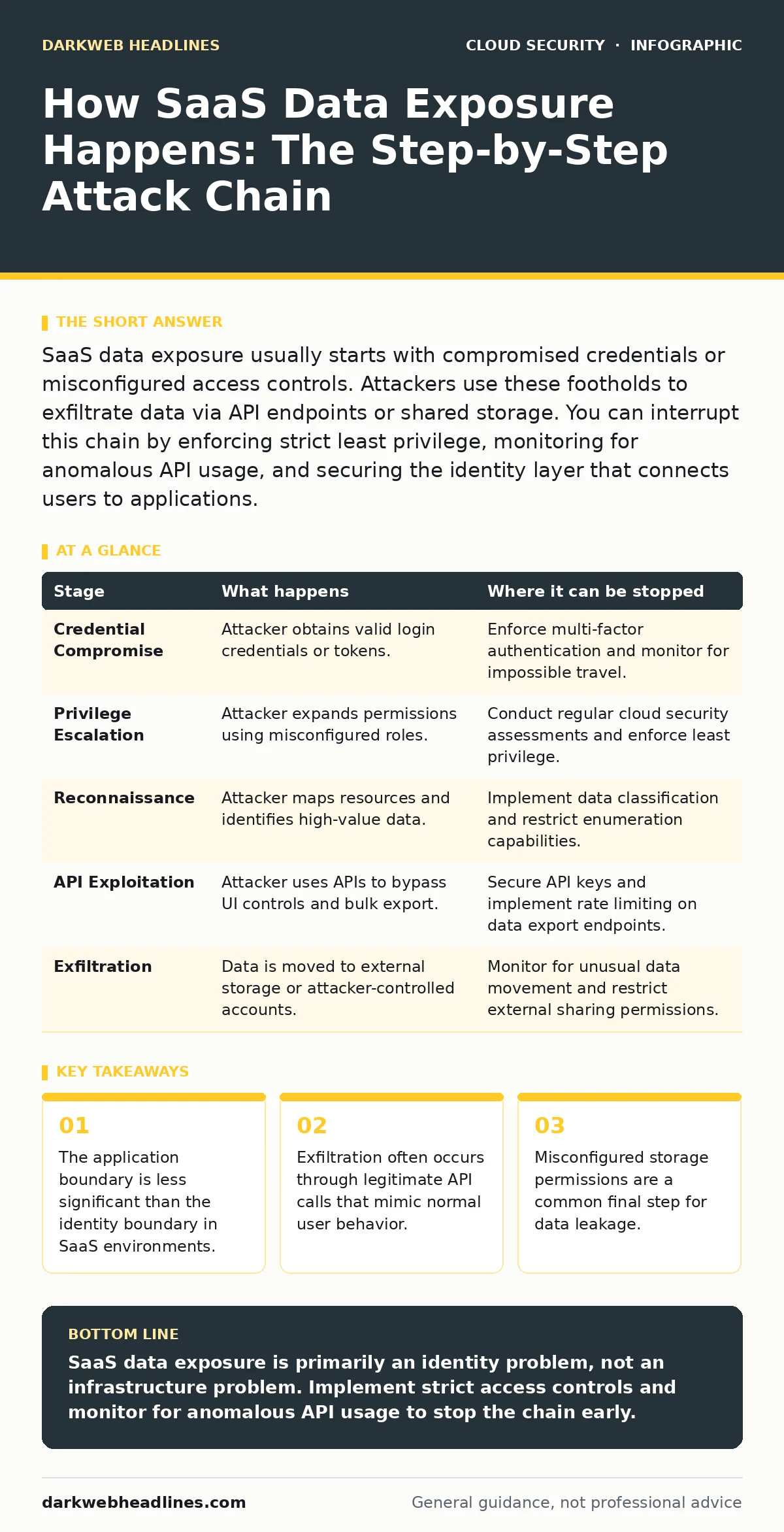
SaaS data exposure usually starts with compromised credentials or misconfigured access controls. Attackers use these footholds to exfiltrate data via API endpoints or shared storage. You can interrupt this chain by enforcing strict least privilege, monitoring for anomalous API usage, and securing the identity layer that connects users to applications.
The Illusion of Perimeter Security
You likely view your SaaS applications as secure black boxes. The vendor manages the infrastructure, patches the software, and handles the physical security. This model shifts your responsibility from infrastructure to identity. The perimeter is no longer a firewall; it is the user account. When that account is compromised or misconfigured, the vendor’s security measures become irrelevant. The data resides in their systems, but the access rights belong to you.
This shift creates a unique vulnerability surface. Attackers do not need to break into the vendor’s database. They only need to convince the application that they are authorized to read or modify data. This authorization often relies on tokens, API keys, or session cookies. If any of these are exposed or poorly managed, the data is accessible.
Stage 1: Credential Compromise or Identity Theft
The chain begins with gaining an initial foothold. This rarely involves complex exploits against the SaaS platform itself. Instead, attackers target the human element or weak authentication configurations. They might use phishing to steal login credentials or exploit a lack of multi-factor authentication. Suppose an employee reuses a password from a breached site. The attacker now has valid credentials for your corporate SaaS environment.
Another vector involves identity sprawl, where accounts are created and forgotten. These dormant accounts often retain high privileges. An attacker who discovers such an account can use it to enter the network without triggering alerts tied to active users. The key insight here is that valid credentials look exactly like legitimate traffic. The application cannot distinguish between a real user and an attacker holding their keys.
Stage 2: Privilege Escalation and Scope Expansion
Once inside, the attacker rarely has direct access to sensitive data. The initial account usually has limited permissions. The next step is to expand that scope. This is where cloud privilege escalation techniques come into play. The attacker looks for misconfigurations that allow a low-privileged user to assume a higher-privileged role.
This often happens through misconfigured IAM roles. If a role allows a user to modify their own permissions, the attacker can grant themselves admin rights. They might also look for service accounts with overly broad access. These accounts are often used by automation scripts and are rarely monitored as closely as human accounts. The attacker pivots from a single user account to a broader set of capabilities.
Stage 3: Reconnaissance and Asset Mapping
With expanded privileges, the attacker begins to map the environment. They need to know what data exists and where it is stored. This stage involves enumerating resources within the SaaS application. They might list all files in a shared drive, query a customer database, or inspect configuration settings.
This phase is quiet. It generates read-only traffic that looks like normal business activity. The attacker identifies high-value targets, such as financial records, intellectual property, or personally identifiable information. They also look for connected services. Many SaaS apps integrate with cloud storage or other applications. These integrations often use API keys that provide access to external data stores.
Stage 4: Exploiting Integration and API Endpoints
Modern SaaS applications rely heavily on APIs to function. These APIs allow different systems to talk to each other. However, they also provide a pathway for data extraction. Attackers often exploit public code repository leaks where developers accidentally commit API keys or secrets. If an attacker finds a valid key, they can interact with the API directly, bypassing the user interface.
The API might allow bulk data export. Suppose the application has a feature to download user lists for marketing purposes. An attacker with the right permissions can use this feature to exfiltrate thousands of records. The application logs this as a legitimate export request. The volume of data might trigger an alert, but the action itself is permitted by the application’s logic.
See also: Cloud Privilege Escalation Myths: What Actually Works · Identity Sprawl: Definition, Hidden Risks, and Control Strategies
Stage 5: Data Staging and Exfiltration
The final stage involves moving the data out of the SaaS environment. Attackers rarely download large files directly to their machines. This would create obvious network traffic. Instead, they stage the data in a neutral location. They might upload the stolen data to a cloud storage bucket they control.
This step often relies on weak storage permissions. If the storage bucket is publicly readable or if the attacker has write access to a shared drive, they can move the data without detection. The data is now outside the SaaS application’s control. The attacker can then retrieve it at their leisure. The original source remains unaware that the data has left until the breach is discovered.
| Stage | What happens | Where it can be stopped |
|---|---|---|
| Credential Compromise | Attacker obtains valid login credentials or tokens. | Enforce multi-factor authentication and monitor for impossible travel. |
| Privilege Escalation | Attacker expands permissions using misconfigured roles. | Conduct regular cloud security assessments and enforce least privilege. |
| Reconnaissance | Attacker maps resources and identifies high-value data. | Implement data classification and restrict enumeration capabilities. |
| API Exploitation | Attacker uses APIs to bypass UI controls and bulk export. | Secure API keys and implement rate limiting on data export endpoints. |
| Exfiltration | Data is moved to external storage or attacker-controlled accounts. | Monitor for unusual data movement and restrict external sharing permissions. |
Interrupting the Chain
You can interrupt this chain at multiple points. The most effective defense is strong identity and access management. This means verifying who the user is and what they are allowed to do. It also means regularly reviewing permissions. Accounts that no longer need access should have it revoked.
Another critical step is monitoring for anomalous behavior. Look for users accessing data they never touch. Look for API calls that happen at unusual times or in unusual volumes. Policy as code can help enforce these rules automatically. By defining what normal behavior looks like, you can spot deviations quickly.
Remember that security is not a product. It is a process. The SaaS vendor secures the platform, but you secure the access. Focus on the identity layer, and you will reduce the risk of data exposure significantly.
Key takeaways
- The application boundary is less significant than the identity boundary in SaaS environments.
- Exfiltration often occurs through legitimate API calls that mimic normal user behavior.
- Misconfigured storage permissions are a common final step for data leakage.
SaaS data exposure is primarily an identity problem, not an infrastructure problem. Implement strict access controls and monitor for anomalous API usage to stop the chain early.
Frequently asked questions
Does multi-factor authentication stop SaaS data exposure?
MFA prevents unauthorized access to accounts, but it does not stop misuse by legitimate accounts. If a user’s account is compromised after MFA, or if permissions are too broad, data can still be exposed.
How do I find misconfigured IAM roles?
Regular cloud security assessments and automated policy checks can identify roles with excessive permissions. Review access logs to see if roles are being used as intended.
Can API keys be stolen from code repositories?
Yes, if developers commit secrets to public repositories, attackers can find them. Use secret scanning tools and enforce policies that prevent committing sensitive data to version control.
What is the role of data classification in SaaS security?
Data classification helps you identify which information is sensitive. This allows you to apply stricter controls to high-value data, reducing the impact if an account is compromised.
How this guide was produced: written by the DarkWeb Headlines editorial team with AI assistance, checked against the public references listed below, and reviewed when the facts change. See our editorial policy or report an error.