Ransomware-as-a-Service Explained: How Criminal Marketplaces Operate
Understanding the subscription model behind modern attacks reveals why security defenses must target business logic, not just code signatures.

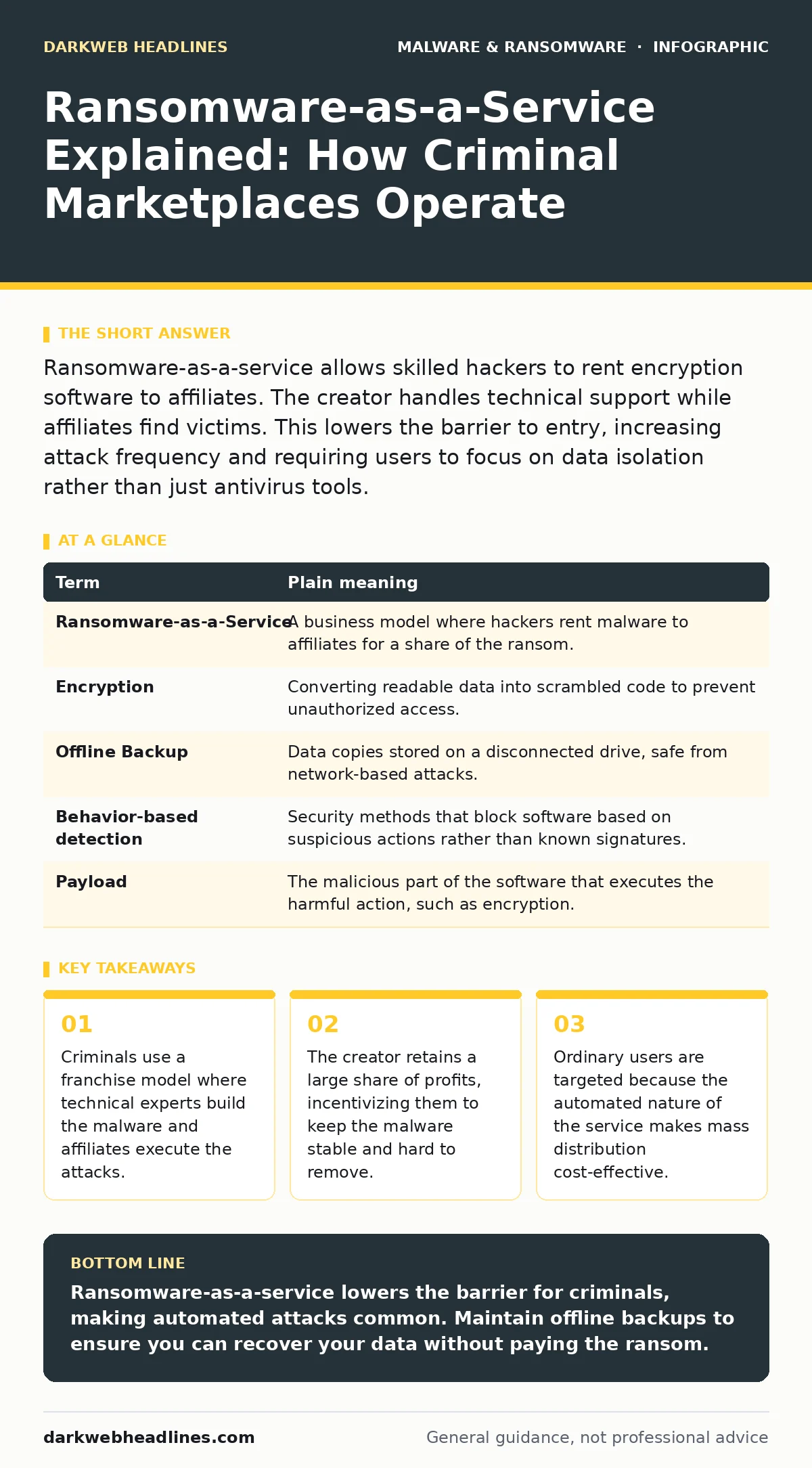
Ransomware-as-a-service allows skilled hackers to rent encryption software to affiliates. The creator handles technical support while affiliates find victims. This lowers the barrier to entry, increasing attack frequency and requiring users to focus on data isolation rather than just antivirus tools.
The Digital Franchise Model
Imagine a high-end catering company. The chefs develop complex recipes and manage the kitchen equipment. They do not deliver the food themselves. Instead, they hire independent drivers who pick up the meals and deliver them to customers. The drivers do not need to know how to cook; they only need to know how to navigate traffic and hand over the package. In return, the catering company takes a large cut of the delivery fee.
Ransomware-as-a-service (RaaS) operates on this exact franchise structure. A sophisticated development team builds the ransomware, which is malicious software designed to encrypt files and demand payment. They then lease access to this software to affiliates, who are often less technically skilled individuals or groups. The affiliates are responsible for finding victims and deploying the malware. The original developers provide the code, the encryption keys, and sometimes even customer support for the affiliates. This division of labor allows criminals to scale their operations without needing every attacker to be a coding expert.
Why This Shift Matters
This business model changes the threat environment significantly. Previously, building effective ransomware required deep programming knowledge and access to underground networks. Now, the technical barrier is nearly zero. An affiliate can purchase access to a RaaS platform using cryptocurrency and receive a dashboard to manage their attacks. The developers have a financial incentive to ensure their product works reliably. If the ransomware fails to encrypt files or is easily removed by standard antivirus software, the affiliate loses money and stops using that platform. This creates a feedback loop where the malware becomes more persistent and harder to detect over time.
The Role of the Affiliate
Affiliates are the front line of these attacks. They do not write the code; they focus on penetration and distribution. They might use malvertising to place ads on legitimate websites that download the malware when clicked. They might send phishing emails that mimic trusted institutions. They often scan for known vulnerabilities in public-facing servers. If you are a small business or an individual with unpatched software, you are a prime target for these low-effort, high-reward attacks. The affiliate’s goal is speed and volume. They want to lock your files quickly before you notice or before you can isolate the infected machine.
Impact on Ordinary Users
You do not need to be a large corporation to be a target. The automation inherent in RaaS makes it easy for affiliates to cast a wide net. If your computer is connected to the internet and has outdated software, it is vulnerable. When ransomware encrypts your files, it renders them unreadable without the decryption key, which is held by the attackers.
The demand for payment is usually in cryptocurrency, which is difficult to trace. For an ordinary user, this means personal photos, documents, and work files can vanish in seconds. The psychological pressure is immediate. You are told that the data will be deleted or leaked if you do not pay. The reality is that paying does not guarantee recovery, and it funds further criminal activity.
Breaking the Chain with Backups
The most effective defense against ransomware is not detection, but recovery. Since you cannot stop every attempt to infect your system, you must ensure that the infection does not destroy your data. Offline backups are critical. These are copies of your data stored on a drive that is not connected to your computer or network when you are not actively using it.
If ransomware encrypts your main drive, the offline backup remains untouched because the malware cannot reach it. You can then restore your files from the clean backup. This breaks the attacker’s leverage. If you have a recent, clean copy of your data, the ransom demand becomes irrelevant. Regularly testing your backups ensures they work when you need them.
See also: Passkeys Explained: How Passwordless Login Actually Works
Behavioral Detection and Hygiene
Traditional antivirus software looks for known signatures of malicious code. RaaS platforms update their code frequently to avoid these signatures. Behavior-based detection is more effective because it looks for suspicious actions rather than specific code. For instance, if a program suddenly starts encrypting thousands of files at once, security software can block it based on that behavior.
You can support this by keeping your operating system and applications updated. Patches often close the vulnerabilities that affiliates use to gain initial access. Additionally, be cautious with malicious browser extensions that can steal credentials or inject ads. Regularly review and remove extensions you do not recognize or no longer use.
| Term | Plain meaning |
|---|---|
| Ransomware-as-a-Service | A business model where hackers rent malware to affiliates for a share of the ransom. |
| Encryption | Converting readable data into scrambled code to prevent unauthorized access. |
| Offline Backup | Data copies stored on a disconnected drive, safe from network-based attacks. |
| Behavior-based detection | Security methods that block software based on suspicious actions rather than known signatures. |
| Payload | The malicious part of the software that executes the harmful action, such as encryption. |
Immediate Safety Habits
You can reduce your risk by adopting simple, consistent habits. These steps do not require advanced technical skills but significantly lower your exposure.
- Enable two-factor authentication on all important accounts. This adds a layer of security even if your password is stolen.
- Keep your software updated. Automatic updates ensure you have the latest security patches without manual effort.
- Verify the source of any file before opening it. If you did not expect an attachment, do not open it.
Key takeaways
- Criminals use a franchise model where technical experts build the malware and affiliates execute the attacks.
- The creator retains a large share of profits, incentivizing them to keep the malware stable and hard to remove.
- Ordinary users are targeted because the automated nature of the service makes mass distribution cost-effective.
Ransomware-as-a-service lowers the barrier for criminals, making automated attacks common. Maintain offline backups to ensure you can recover your data without paying the ransom.
Frequently asked questions
Can antivirus software stop ransomware?
Antivirus helps, but modern ransomware often bypasses signature-based detection. You need behavior-based monitoring and offline backups for true protection.
Is it safe to pay the ransom?
No. Paying does not guarantee you will get your files back, and it encourages more attacks. It also funds criminal operations.
How do affiliates find victims?
They use automated tools to scan for vulnerabilities, send phishing emails, and exploit unpatched software weaknesses.
What is the difference between RaaS and regular malware?
RaaS is a business model where the creators provide tools and support to affiliates, whereas regular malware is often developed and deployed by a single entity.
How this guide was produced: written by the DarkWeb Headlines editorial team with AI assistance, checked against the public references listed below, and reviewed when the facts change. See our editorial policy or report an error.