Angler Phishing Myths: What You Believe Is Wrong
Angler phishing hides inside legitimate support pages, not just fake emails, making standard email filters useless against this silent threat.

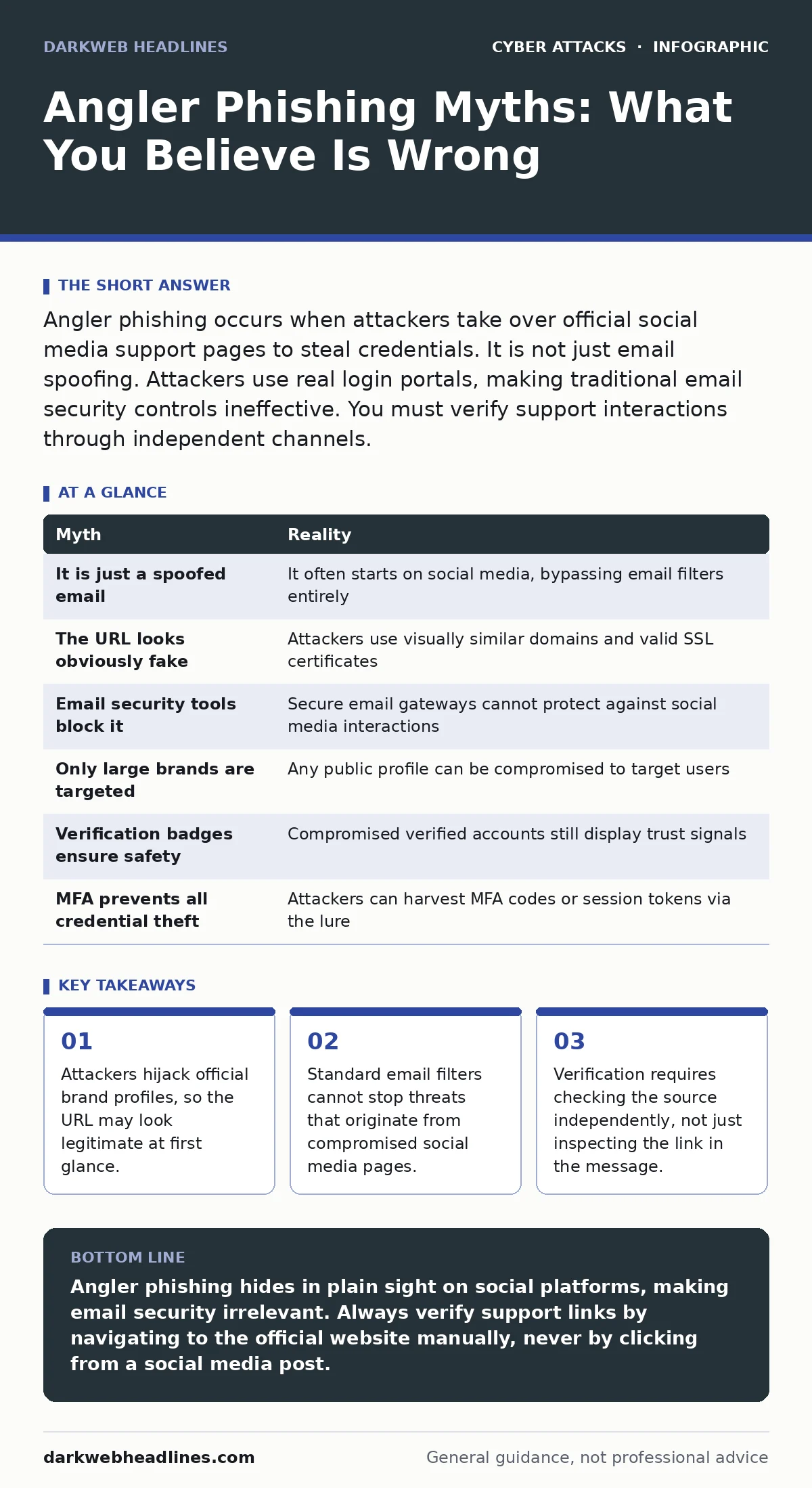
Angler phishing occurs when attackers take over official social media support pages to steal credentials. It is not just email spoofing. Attackers use real login portals, making traditional email security controls ineffective. You must verify support interactions through independent channels.
Myth: It Is Just a Spoofed Email Address
Reality: You assume the threat arrives in your inbox with a sender address that looks slightly wrong. In angler phishing, the email might be legitimate, or you might not receive an email at all. The attack begins on a social media platform where a brand posts publicly. The attacker has compromised the brand’s official support account or created a convincing duplicate. They respond to your public complaint with a link. The deception relies on the trust you place in the platform’s interface, not the email header. You click because the context feels safe. The malicious payload or credential harvester lives on a domain the attacker controls.
Myth: The URL Always Looks Obvious
Reality: You expect to see misspelled domains or strange top-level extensions that scream fraud. Angler phishing often uses subdomains that mirror the legitimate brand. The attacker registers a domain that is visually similar to the company’s official site. They then host a login page that is an exact copy of the real one. The URL bar shows the attacker’s domain, but the page content is identical to the official site. Your browser may even show a secure connection padlock if the attacker uses a valid SSL certificate. The lock icon proves the connection is encrypted, not that the destination is trustworthy. You must inspect the hostname, not just the page design.
Myth: Email Security Tools Will Block It
Reality: You believe your organization’s secure email gateways will catch these threats. These tools scan incoming messages for malicious links and attachments. They work by analyzing the email protocol and content. Angler phishing bypasses this entirely because the interaction happens on a social network.
The attacker posts a comment or sends a direct message. No email is involved in the initial lure. Even if the attacker sends a follow-up email, it may come from a legitimate account they have compromised. The security tool sees a known sender and a clean message. The threat vector is outside the scope of email filtering. You need application-layer awareness, not just perimeter defense.
Myth: It Only Targets Large Corporations
Reality: You think only major brands with high-profile social media accounts face this risk. Attackers target any entity with a public presence. Small businesses, local services, and even personal profiles are vulnerable. The goal is often credential harvesting or malware distribution. The attacker does not need a huge following to find victims. They search for keywords like "help" or "support" in comments. They respond to anyone asking for assistance. The scale of the brand matters less than the urgency of the user’s problem. A frustrated customer is more likely to click without thinking. The attack exploits human emotion, not brand size.
Myth: You Can Trust the Social Platform’s Verification
Reality: You assume that if a profile has a verification badge, it is safe. Attackers can compromise verified accounts. Once inside, they have full control over the posts and comments. The badge remains visible, signaling authenticity to you. The platform’s security measures protect the account owner, not the people interacting with the content.
If the attacker has the login credentials, they can post malicious links as the official brand. You cannot rely on the platform’s trust signals to validate the safety of a specific link. You must verify the action outside the platform. This is similar to how session hijacking can steal access even when the login was correct.
Myth: Multi-Factor Authentication Stops the Theft
Reality: You believe that having MFA enabled makes you immune to credential theft. MFA protects your account if the attacker only has your password. In angler phishing, the attacker often seeks to bypass MFA or steal the session token. They may direct you to a page that asks for your MFA code. You enter it, thinking you are logging in.
The attacker uses that code to complete the login on their side. Alternatively, they may use a technique similar to passkeys phishing, where they trick you into approving a login request. If the attacker captures your credentials and the MFA factor, they have full access. MFA is a layer of defense, not a silver bullet. It slows down the attacker but does not prevent the initial deception.
Myth: It Is Rare and Uncommon
Reality: You underestimate the frequency of these attacks because they do not make news headlines. Angler phishing is a persistent and evolving threat. Attackers automate the search for victim interactions. They use bots to scan for complaints and respond instantly. The volume is high, but the success rate per attack is low. Attackers cast a wide net. The ones who succeed are the ones who act quickly. The lack of visibility does not mean the threat is absent. It means the attacks are quiet and targeted. You must maintain a consistent level of skepticism. The attack pattern is well-established and widely used by threat actors.
| Myth | Reality |
|---|---|
| It is just a spoofed email | It often starts on social media, bypassing email filters entirely |
| The URL looks obviously fake | Attackers use visually similar domains and valid SSL certificates |
| Email security tools block it | Secure email gateways cannot protect against social media interactions |
| Only large brands are targeted | Any public profile can be compromised to target users |
| Verification badges ensure safety | Compromised verified accounts still display trust signals |
| MFA prevents all credential theft | Attackers can harvest MFA codes or session tokens via the lure |
Key takeaways
- Attackers hijack official brand profiles, so the URL may look legitimate at first glance.
- Standard email filters cannot stop threats that originate from compromised social media pages.
- Verification requires checking the source independently, not just inspecting the link in the message.
Angler phishing hides in plain sight on social platforms, making email security irrelevant. Always verify support links by navigating to the official website manually, never by clicking from a social media post.
Frequently asked questions
How do I know if a social media profile is compromised?
Look for generic responses, links to unusual domains, or a sudden change in posting style. Verify the account’s existence on the official company website.
Can I use CAPTCHA to prevent angler phishing?
No. CAPTCHA prevents automated bots from posting, but it does not stop human attackers or compromised accounts from posting malicious links.
Should I report the attack to the social platform?
Yes. Reporting helps the platform remove the malicious content and may lock the compromised account, stopping further attacks.
Does BGP hijacking play a role in angler phishing?
No. BGP hijacking redirects internet traffic at a network level. Angler phishing relies on social engineering and compromised accounts, not network routing manipulation.
How this guide was produced: written by the DarkWeb Headlines editorial team with AI assistance, checked against the public references listed below, and reviewed when the facts change. See our editorial policy or report an error.